Hochul Paused Carbon Pricing to Get More Feedback — But Hasn’t Asked for Any

State officials said they needed more time for “stakeholder engagement” on cap and invest. But groups involved with the program have gotten crickets.

Colin Kinniburgh   ·   June 6, 2025
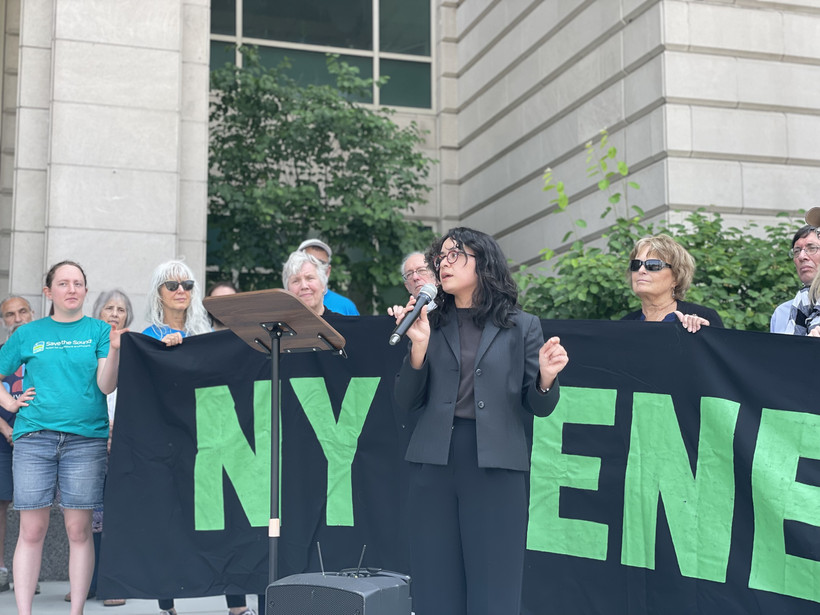
State Assemblymember Claire Valdez speaks at a rally in front of people holding a banner that reads "NY Renews."
New York state Assemblymember Claire Valdez speaks at an Albany rally held by advocates in support of a long-promised carbon pricing program that Governer Kathy Hochul delayed earlier this year. June 4, 2025. | NY Renews

Sign up for Staying Focused, our newsletter keeping readers up to speed on New York politics.

When Governor Kathy Hochul abruptly hit the brakes in January on a sweeping program to price pollution, she said the state needed more time to “get it right.”

Holding off on the cap and invest program would allow “more space and time for public transparency,” her 2025 agenda briefing book promised.

Later that month, the then–head of the state’s Department of Environmental Conservation told lawmakers that the agency would “continue the robust stakeholder engagement we have had over the past few months” on New York’s plan to ratchet down pollution while raising billions for the transition to clean energy.

Four months on, there’s little sign that Hochul’s administration has continued those efforts.

Climate advocates who had discussed details of cap and invest with state officials late last year — as Hochul prepared to launch the long-anticipated program — told New York Focus they haven’t heard anything from the administration since then about the core parts of the program.

Instead, DEC is focused on a narrower component of it: creating rules for how companies would be required to report their greenhouse gas emissions. The agency published a draft version in late March, and held hearings on those rules this week, as part of a mandatory public review process — marking the state’s first public forum on cap and invest since Hochul’s about-face in January. Climate groups and legislators rallied outside hearings in Syracuse and Albany on Tuesday and Wednesday, and are planning to do the same in New York City next week, demanding that Hochul’s administration release the full regulations to implement the carbon pricing program.

DEC spokesperson Lori Severino said the reporting regulation “lays the foundation for a future cap-and-invest program.”

But the centerpiece of the program — an auction system requiring companies to pay for the right to pollute — remains on hold. (Cap and invest, as proposed over the last two years, hinged on three pieces of regulation: the reporting rule, as well as one to determine which emissions polluters to charge and another to structure how the auctions should run.)

DEC did not provide any examples of recent “stakeholder engagement” on that front, except to note that web portals soliciting public comments on how cap and invest funds should be raised and spent remain open.

Nor has Hochul’s administration sought meetings behind the scenes, according to several groups.

“I haven’t heard anything recently,” said Conor Bambrick, senior climate adviser at the NYC Environmental Justice Alliance. He was one of many climate advocates who met with the Hochul administration in December, when officials were seeking to build support for the expected announcement of cap and invest rules in January.

“Our coalition members continue to try and engage with the executive around the urgent need to move forward with cap and invest this year,” said Stephan Edel, executive director of the climate justice coalition NY Renews. “It’s frustrating how little we’ve heard from the governor on a program that would benefit residents statewide.”

One climate advocate, who requested anonymity due to ongoing dealings with the administration, said that some staff at the state energy authority NYSERDA who had been working on cap and invest outreach had been moved to other projects. (A NYSERDA spokesperson said staff routinely work on multiple projects at a time.)

Alongside its work on the technical regulations, NYSERDA led sessions last August and September seeking feedback — particularly from environmental justice groups — on how to spend the proceeds from cap and invest. Regulators laid out a framework for the investments and specific prompts for written comments, asking for replies by the end of last September. Officials said the feedback would help inform the state’s budget for this fiscal year.

But with cap and invest on pause, lawmakers instead agreed this spring on a one-time, $1 billion pot of climate funding from the state’s general budget — more than the state had ever committed before, but less than the $3 billion cap and invest was expected to raise in its first year. NYSERDA has not continued its outreach on a longer-term spending plan.

Vanessa Fajans-Turner, executive director of the group Environmental Advocates NY said that her organization, like others, hasn’t gotten any recent updates from state officials on the overall cap and invest program. But she sees the emissions reporting rule as a step in the right direction.

“This reporting rule is progress — and we’re glad to see DEC taking steps to hold polluters accountable. But we have to be honest with ourselves: knowing who’s polluting doesn’t stop the pollution,” Fajans-Turner said in a statement Wednesday.

New York’s climate law required that the state issue regulations to meet its binding emissions targets by the beginning of 2024, and cap and invest was designed to help meet it. Many advocates were willing to give regulators longer to fine tune the program, as long as it was clear they were making progress.

Now that Hochul has hit the brakes, it’s a different story. Four climate groups sued the state in late March in a bid to get the program back on track.

Bambrick, of the Environmental Justice Alliance, said there was no reason to wait for a final reporting rule to move ahead with the rest of the program. (His group is not party to the lawsuit.)

“This was pitched as three sets of regulations that needed to move forward. They can all move forward together,” he said. “We’re running out of time. These should have been implemented a year and a half ago, and we’d like to see them start to move forward now.”

I hope this article helped you better answer the question that guides all of our journalism: Who runs New York? Before you click away, please consider supporting our work and making more stories like this one possible.

New York state is standing at a crossroads for climate action. After passing one of the nation’s most ambitious climate laws in 2019, the state is lagging far behind on its targets, struggling to meet deadlines to build renewable energy and clean up its buildings and roads. Other states are closely watching our progress, making decisions about their own climate plans based on New York’s ability to implement this legislation.

As New York’s only statewide nonprofit news publication, we’ve been scrutinizing the state’s climate progress. Our journalism exists to unpack how power works in New York, analyze who’s really calling the shots, and reveal how obscure decisions shape ordinary New Yorkers’ lives.

But we can't do this work without your help. We rely on reader donations to help sustain our outlet, and every gift directly allows us to publish more pieces like this.

Our work has already shown what can happen when those with power know that someone is watching, with my reporting prompting a state investigation and fine for a major corporation. I have more story ideas than I can count, but only limited resources to pursue all the leads that come across my desk.

If you’re able, please consider supporting our journalism with a one-time or monthly gift. Even small donations make a big difference.

Thank you for reading.

Colin Kinniburgh
Climate and Environmental Politics Reporter
A photo of Colin Kinniburgh.
Colin Kinniburgh is a reporter at New York Focus, covering the state’s climate and environmental politics. He has worked in media for more than a decade, across print, television, audio, and online news, and participated in fellowship programs at CUNY’s Graduate School of Journalism… more
Also filed in New York State

The legislation would make it easier for currently and formerly incarcerated people and child victims to sue the state over allegations of past abuse.

State leaders are expected to pass a bill that avoids resolving how much Resorts World New York City needs to pay.

New York state has pumped millions of taxpayer dollars into an online portal that vowed to make life easier for Rochester’s neediest, but critics say it’s fallen short.

Also filed in Climate and Environment

Governor Kathy Hochul was successful in her bid to upend the Climate Leadership and Community Protection Act after legislators caved to finalize an overall budget deal.

The leader of Reinvent Albany discusses a data center subsidy in Rockland County that flew under the radar for years.

No other project in the country has gotten such a large subsidy to create so few jobs, according to watchdogs.