Trump Targets Bail Reform in Latest Threat to New York’s Federal Funding

New York’s bail reform law didn’t eliminate cash bail and hasn’t led to increased crime or recidivism. The Trump administration is still targeting it.

Chris Gelardi   ·   August 26, 2025
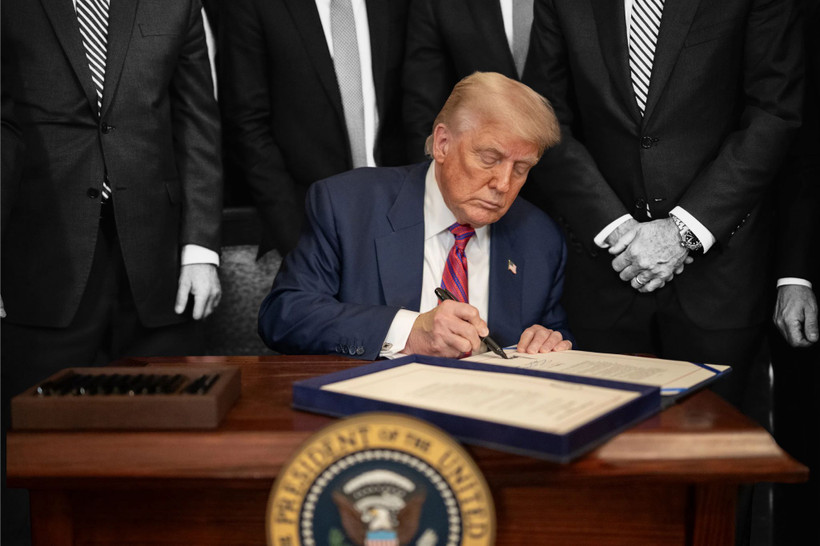
Trump signing an executive order
President Donald Trump has New York's bail reforms in his sights. | Photo: The White House; Illustration: New York Focus

Sign up for Staying Focused, our newsletter keeping readers up to speed on New York politics.

On Monday, President Donald Trump signed an executive order threatening to withhold federal funding from states and localities that have enacted “cashless bail policies.” The order instructs Attorney General Pam Bondi to compile a list of jurisdictions that have “substantially eliminated” their cash bail systems, which require criminal defendants who can’t afford court-imposed collateral to sit in jail while awaiting trial.

The administration could move to suspend or terminate those jurisdictions’ federal grants and contracts, the order said.

Trump signaled that he has New York in his sights, even though the state allows cash bail for almost all of the offenses the order describes. That could put the state’s 2019 pretrial detention reforms at risk — though similar moves by the Trump administration have met hurdles in federal courts.

Few jurisdictions across the country have outlawed or nearly outlawed cash bail; among them are Washington, DC, where Trump is attempting to federalize local law enforcement, and Illinois, the first state to fully do so. New York is not on that list. The 2019 overhaul of the Empire State’s bail statute barred judges from demanding cash collateral from people charged with most misdemeanors and some nonviolent felonies, but it left the option in place for a majority of felony cases.

Tough-on-crime politicians from both major parties have repeatedly sought to dismantle the reforms, and bail has remained one of New York’s most salient political issues. Democratic Governor Kathy Hochul has spent considerable political capital rolling back bail reform, forcing through legislation that gave judges greater discretion to keep defendants incarcerated and made new types of charges, including some misdemeanors and nonviolent felonies, bail-eligible. Still, many critics have remained unsatisfied — including the president.

Earlier this month, Trump incorrectly claimed that the “radical left [New York] City Council” (bail reform is a state law) “adopted no-cash bail” (cash bail still exists in New York) and “started the [crime] problem” (research has found that bail reform has not measurably increased crime rates). A White House press release accompanying the executive order said that bail reform laws have turned “cities into hunting grounds for repeat criminals who mock our justice system by committing crime after crime without consequence,” listing seven instances of New York judges releasing the so-called repeat criminals or those accused of serious crimes pending their trials.

Trump’s allies in New York celebrated the order. US Representative Elise Stefanik, a northern New York Republican who’s reportedly planning to challenge Hochul in the 2026 gubernatorial election, released a statement Monday arguing that “Kathy Hochul and NY Democrats [sic] failed bail reform has been a catastrophic disaster leading to a crime crisis in New York making every family and community less safe.”

Studies show that bail reform has so far had either positive or no effects on recidivism, noted Michael Rempel, director of the Data Collaborative for Justice at John Jay College, which has closely tracked the effects of bail reform in New York. One data analysis showed that, over two years, bail reform contributed to lower rearrest rates in New York City. A similar study on suburban and upstate areas showed that bail reform had no statistically significant impact on recidivism, while a statewide study from University at Albany scholars uncovered no significant impact on reported crime rates.

Studies of Harris County, Texas, which also enacted limited reforms for misdemeanor charges, and New Jersey, which more severely restricted cash bail and implemented a risk-based system for determining whether to jail people pretrial, yielded similar results. Research in other jurisdictions generally shows that pretrial detention increases the risk of new arrest, Rempel pointed out.

Trump’s executive order gave the attorney general 30 days to identify states and localities to target. The order offered discretion, requiring a list of jurisdictions that, in the attorney general’s “opinion,” “substantially eliminated cash bail … for crimes that pose a clear threat to public safety and order, including offenses involving violent, sexual, or indecent acts, or burglary, looting, or vandalism” — almost all of which remain bail-eligible in New York.

If New York state ends up on Bondi’s list, Albany will find itself in familiar territory facing cuts to federal programs — a central policy objective for the Trump administration and its go-to threat for states and localities that don’t bow to its demands. Such ultimatums have wreaked havoc in statehouses and local legislative chambers, though some courts have ruled that a majority of congressionally approved federal spending is immune from unilateral action by the White House.

In New York, federal judges have repeatedly blocked the Trump administration’s attempts to withhold federal funding unless the state kills its congestion pricing program for lower Manhattan tolls. Other cases have seen courts block Trump administration attempts to cut funding to so-called sanctuary cities and to schools over their diversity, equity, and inclusion initiatives.

When it comes to bail, key officials in New York’s Democratic majority are so far defending it against Trump’s forthcoming attacks.

“President Trump has no concept of how the law works in New York,” Jen Goodman, a spokesperson for Hochul’s office, said in a statement. “New York has not eliminated cash bail. His reckless threat to withhold federal funds would only undercut law enforcement and make our communities less safe.”

BEFORE YOU GO, consider: If not for the article you just read, would the information in it be public?

Or would it remain hidden — buried within the confines of New York’s sprawling criminal-legal apparatus?

I started working at New York Focus in 2022, not long after the outlet launched. Since that time, our reporters and editors have been vigorously scrutinizing every facet of the Empire State’s criminal justice institutions, investigating power players and the impact of policy on state prisons, county jails, and local police and courts — always with an eye toward what it means for people involved in the system.

That system works hard to make those people invisible, and it shields those at the top from scrutiny. And without rigorous, resource-intensive journalism, it would all operate with significantly more impunity.

Only a handful of journalists do this type of work in New York. In the last decades, the number of local news outlets in the state has nearly halved, making our coverage all the more critical. Our criminal justice reporting has been cited in lawsuits, spurred legislation, and led to the rescission of statewide policies. With your help, we can continue to do this work, and go even deeper: We have endless ideas for more ambitious projects and harder hitting investigations. But we need your help.

As a small, nonprofit outlet, we rely on our readers to support our journalism. If you’re able, please consider supporting us with a one-time or monthly gift. We so appreciate your help.

Here’s to a more just, more transparent New York.


A photo of Chris Gelardi
As New York Focus’s justice bureau chief, Chris Gelardi reports and edits work on the state’s criminal-legal and immigration systems. His writing on cops, jails, ICE, and the US military has appeared in more than a dozen other outlets, most frequently The Intercept… more
Also filed in Criminal Justice

In May, state lawmakers passed a $269 billion budget after haggling for months over thousands of line items and policies affecting New Yorkers.

The legislation would make it easier for currently and formerly incarcerated people and child victims to sue the state over allegations of past abuse.

It’s unclear whether the Correctional Association of New York will have to scale back its nascent reform initiatives.

Also filed in New York State

Millions in outside spending was a boon to Gov. Kathy Hochul’s 2022 opponent, Lee Zeldin, and influenced down-ballot races.

State leaders are expected to pass a bill that avoids resolving how much Resorts World New York City needs to pay.

New York state has pumped millions of taxpayer dollars into an online portal that vowed to make life easier for Rochester’s neediest, but critics say it’s fallen short.

Also filed in New York City

Resorts World is floating legislation to avert more than $500 million in payments to the horseracing industry.

Some of the city’s new aid will be canceled out by pension boosts.

The Department of Justice has terminated more than 100 immigration judges since last year as it has pressured courts to order more deportations.