Is a Solution to New York’s Food Stamp Theft Finally on the Horizon?

New Yorkers could see new benefit cards in 2027 as officials pledge to prioritize a long-awaited upgrade.

Jie Jenny Zou   ·   February 27, 2026
In January, Governor Kathy Hochul officially came out in support of transitioning to chip-enabled benefit cards. | Hochl photo: Susan Watts/Office of Governor Kathy Hochul | Illustration: Leor Stylar

Sign up for Staying Focused, our newsletter keeping readers up to speed on New York politics.

An overdue update to New York’s benefit cards that could prevent food stamp theft could launch as early as next February.

Last month, Governor Kathy Hochul officially came out in support of transitioning to chip-enabled benefit cards, reversing the state’s stance from just a year ago.

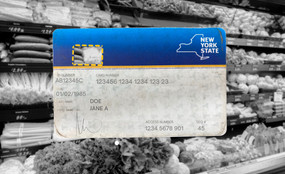
The cards New York currently uses for the Supplemental Nutrition Assistance Program and cash assistance lack the encrypted chips that have been standard in credit and debit cards for over a decade, leaving users prone to a form of theft called skimming. 

The state has been a skimming hotbed, with at least $51 million worth of food benefits stolen since 2023. While the state replaces stolen cash assistance, SNAP skimming victims have not been eligible for refunds since a congressional reimbursement program ended in December 2024. Anti-hunger advocates have for years urged the state to upgrade the cards to protect households against theft and prevent the state from having to repay stolen benefits.

“It’s such a huge step up in momentum from where we were last year,” said Alison Roberts, attorney at Legal Services New York, which is suing the state for failing to adopt chip technology and leaving recipients vulnerable to fraud. But, she added, “we’re all aware the transition is not going to happen overnight.”

How to secure your SNAP benefits:


Freeze your EBT card when not in use using the ebtEDGE mobile app.

• Change your PIN frequently. You can change your PIN at local departments of social services offices, Benefit Access Centers, or by calling 888-328-6399 or visiting www.ebtEDGE.com.

• Monitor your EBT account regularly for any suspicious activity.

• Protect your PIN by covering the keypad when you enter it at checkout.

• Be on the lookout for skimming devices.

Assemblymember Jessica González-Rojas, who has long pushed the state to adopt more secure cards, said she was “thrilled” to finally see the governor commit to the change. “It’s in our best interest to make the transition happen sooner rather than later,” she said.

Neither Hochul’s State of the State book nor her executive budget proposal included a timeline for the transition, however — or a dedicated pot of money for the upgrade. In a budget hearing earlier this month, the head of the Office of Temporary and Disability Assistance, which oversees SNAP, told legislators the earliest New Yorkers could see new cards would be February 2027.

“We will move as quickly as we can,” said Commissioner Barbara Guinn, calling chip cards a “high priority” for her agency over the next 12 to 18 months. 

That timeframe could face snags under President Donald Trump’s administration, which has sought to withhold a variety of federal dollars from New York. The transition requires the state to coordinate with the US Department of Agriculture, which oversees SNAP nationally and has been hit by wide-scale layoffs and consolidation.

New York’s current benefit cards feature magnetic strips that are highly vulnerable to skimming devices, which are placed on card readers at checkout counters and can capture sensitive account information. Transitioning to the more secure cards would require the state to replace all benefit cards and work closely with retailers to upgrade and test their software systems to accept the new payment method.

At the February 5 budget hearing, Guinn said her agency planned to award a vendor contract for chip cards in the coming weeks, but she was hesitant to commit to an overall timeframe, initially dodging questions from several legislators about how soon New Yorkers could expect new cards. She provided a rough timeline after being pressed by state Senator John Liu, whose Queens district has been hit especially hard by skimming.

“This punishes people for something they couldn’t possibly prevent.”

—Ed Josephson, Legal Aid Society

“This is not modern, leading edge technology. … It’s not rocket science,” said Liu, who insisted the state should at least have an “aspirational” deadline.

Several other states are farther along than New York when it comes to upgrading benefit cards. California became the first state to issue chip-enabled cards last April, but the process was riddled with technical snags and delays. Oklahoma and New Jersey are planning to debut the new cards later this year, but state officials declined to specify rollout dates when asked by New York Focus.

Early results from California indicate the transition has been effective. Reports of skimming in California have dropped by 83 percent since November 2025. That figure could improve as more retailers upgrade their payment systems in the coming months. In an email, California social services officials said that over half of all card transactions in December 2025 utilized chips.

The cost of the transition in New York remains unclear. At last year’s budget hearing, Guinn estimated the switch could cost the state $20 million, with the federal government providing $20 million in matching funds, and said the state could not afford the expense.

That price tag is likely to go up. Starting in October, Washington will reduce its share of SNAP administrative costs, which help pay for upgrades like chip cards, from 50 percent to 25 percent. The policy shift is among several changes under the megabill signed last summer, which is expected to result in hundreds of thousands of New Yorkers losing their SNAP benefits unless the state takes action.

Emails obtained by New York Focus show the state has been considering chip cards for years, but has been slow to act. Guinn’s staff has been in close communication with California officials about chip cards since 2022, with some messages indicating the state had previously considered opening contractual bids for chip cards as far back as September 2024. State officials have so far declined to answer New York Focus’s questions about the delay or release public records on the matter. 

In an email to New York Focus, OTDA spokesperson Darren O’Sullivan declined to say whether the state had secured federal approval or funding for the transition. “As federally funded nutrition programs like SNAP are under attack in Washington, Governor Hochul has been laser-focused on protecting the dollars that New Yorkers depend on and ensuring they can access resources necessary to uplift them and their families,” O’Sullivan wrote.

Ed Josephson, a supervising attorney at the Legal Aid Society, said the federal government has little incentive to address skimming when it isn’t forced to replace stolen SNAP funds. Congress failed to extend a limited reimbursement program for SNAP skimming victims that ended in December 2024. (The USDA still replaces benefits from cards that are physically stolen.) A handful of states, including California, have opted to reimburse victims using their own state funding. Advocates have been calling on New York to do the same.

“We would love for New York to do something similar,” said Roberts, pointing to current bills circulating in the state Senate and Assembly that call for a compensation fund. Neither of the bills was mentioned in Hochul’s budget plans last month, and Guinn declined to take a position on the issue when asked during the budget hearing.

“There were days I would just feed my son and not myself.”

—S.O., Plaintiff in an ongoing lawsuit against the USDA

González-Rojas, who sponsors the Assembly bill, said she was disappointed to see SNAP reimbursement missing from the governor’s budget plan, but is hopeful that state legislators will take up the matter in their budget proposals that will be released next month. “We really want to make our families whole,” said González-Rojas, who is also sponsoring SNAP for All, a bill that would provide state-funded nutrition benefits for immigrant New Yorkers no longer eligible for federal SNAP under Trump administration policies. 

Refunds could be a godsend for skimming victims like S.O., a 29-year-old single mother in the Bronx whose SNAP theft occurred before Congress set up its reimbursement program. 

“I was like, ‘Oh god, we’re going to starve,’” she said after noticing several hundred dollars of her benefits had been used in Texas in early 2022. “I’ve never even been to Texas.”

S.O. is a plaintiff in an ongoing federal class action lawsuit filed by the Legal Aid Society against the USDA for not refunding skimmed benefits. (S.O., whom the lawsuit refers to by her initials, resides in a domestic violence shelter with her 5-year-old son and asked to remain anonymous for safety reasons.)

“I had to make things stretch a whole lot, and there were days I would just feed my son and not myself,” she said of the weeks following the theft. She’s spent the four years since then living in a state of “paranoia,” keeping her card digitally locked between grocery trips using an app on her phone and avoiding local bodegas out of fear of a repeat theft. She never received a refund for the stolen funds. 

November’s government shutdown, which led to an unprecedented nationwide delay in SNAP benefits, has only worsened her anxiety around the program’s reliability. She now tries to save at least $80 on her card at the end of every month in case benefits arrive late again.

S.O. has been disappointed by the state’s lack of urgency on chip cards. “I think they’re being irresponsible. We’ve been sounding the alarm on this since early 2022,” she said. “It could have been done by now.” 

Josephson, the Legal Aid attorney, urged the state to move forward with refunds to ensure SNAP recipients do not continue to be victimized by political inaction.

“This punishes people for something they couldn’t possibly prevent,” he said of SNAP clients like S.O. “People with means would never stand for that, but all these years they’ve allowed the people who can least afford it to lose the most.”

At New York Focus, our central mission is to help readers better understand how New York really works. If you think this article succeeded, please consider supporting our mission and making more stories like this one possible.

New York is an incongruous state. We’re home to fabulous wealth — if the state were a country, it would have the tenth largest economy in the world — but also the highest rate of wealth inequality. We’re among the most diverse – but also the most segregated. We passed the nation’s most ambitious climate law — but haven’t been meeting its deadlines and continue to subsidize industries hastening the climate crisis.

As New York’s only statewide nonprofit news publication, our journalism exists to help you make sense of these contradictions. Our work scrutinizes how power works in the state, unpacks who’s really calling the shots, and reveals how obscure decisions shape ordinary New Yorkers’ lives.

In the last two decades, the number of local news outlets in New York has been nearly slashed in half, allowing elected officials and powerful individuals to increasingly operate in the dark — with the average New Yorker none the wiser.

We’re on a mission to change that. Our work has already shown what can happen when those with power know that someone is watching, with stories that have prompted policy changes and spurred legislation. We have ambitious plans for the rest of the year and beyond, including tackling new beats and more hard-hitting stories — but we need your help to make them a reality.

If you’re able, please consider supporting our journalism with a one-time gift or a monthly gift. We can't do this work without you.

Thank you,


A photo of Jie Jenny Zou.
Jie Jenny Zou covers social services and public benefits for New York Focus. She previously worked as an investigative reporter at the Los Angeles Times and the Center for Public Integrity where she delved into topics ranging from environmental health and worker safety… more
Also filed in New York State

In May, state lawmakers passed a $269 billion budget after haggling for months over thousands of line items and policies affecting New Yorkers.

Millions in outside spending was a boon to Gov. Kathy Hochul’s 2022 opponent, Lee Zeldin, and influenced down-ballot races.

The legislation would make it easier for currently and formerly incarcerated people and child victims to sue the state over allegations of past abuse.

Also filed in Social Services

New York state has pumped millions of taxpayer dollars into an online portal that vowed to make life easier for Rochester’s neediest, but critics say it’s fallen short.

We’ve compiled information for SNAP recipients in New York on the changing work requirements.

Despite last-ditch efforts by a coalition of lawmakers, the state failed to avert a health coverage cliff coming this summer.

Also filed in Affordability

Governor Kathy Hochul was successful in her bid to upend the Climate Leadership and Community Protection Act after legislators caved to finalize an overall budget deal.

The Hochul administration now has a chance to relax New York’s child care staffing ratios — among the country’s strictest — after 26 years. But will it?