New Legislation Would Advance ‘Virtual Power Plants’ in New York

A bill introduced by Assemblymember Anna Kelles aims to harness home batteries, electric vehicles, and other clean tech to meet reliability needs.

Colin Kinniburgh   ·   March 4, 2026
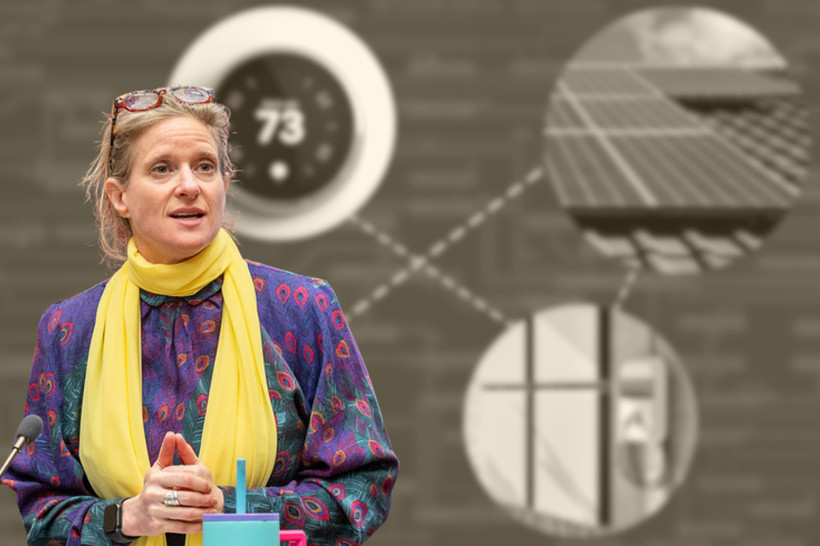
Assemblymember Anna Kelles introduced legislation on Thursday that would require all of the state’s major electric utilities to create “virtual power plants." | Anne Kelles photo: New York state Assembly Majority; Background photos: andiiwan, anuka5296, Jirasukhanont, Jordi Calvera/Canva | Illustration: New York Focus

Sign up for Staying Focused, our newsletter keeping readers up to speed on New York politics.

A New York state lawmaker wants to accelerate the state’s transition to a more flexible electric grid.

Assemblymember Anna Kelles, of Ithaca, introduced legislation last week that would require the state’s major electric utilities to create “virtual power plants” — networks of home batteries, smart thermostats, electric vehicles, and other devices that companies can draw on to keep the lights on at peak times. It aims to rapidly scale up the programs by creating new incentives for customers to participate.

The idea behind the bill is gaining traction among energy experts as states contend with rising electricity demand and soaring energy bills, as New York Focus recently reported.

Flexible grid programs could help New Yorkers save money and cut pollution, a highly sought-after combination amid a bruising fight over the costs of achieving the state’s climate targets. A mammoth report published last fall by the state energy authority NYSERDA found that virtual power plants will be one of the key tools to achieve a reliable, zero-emissions grid, as the state’s climate law requires — and that they are cheaper and quicker to deploy than some of the other technologies the state envisions, like hydrogen or next-generation nuclear.

New York was early to champion the idea of a more flexible grid, through the “Reforming the Energy Vision” initiative, or REV, launched in 2014 by then-Governor Andrew Cuomo. Governor Kathy Hochul has backed renewed reform efforts. But New York has repeatedly fallen behind on these efforts, even as other states have raced ahead.

“The REV was a really important step, but it didn’t manifest in the way that one would hope,” Kelles said. “And that’s where this bill comes in.”

Kelles’s bill, dubbed the Grid Reliability and Energy Affordability Transition Act, would require utilities to create three kinds of programs: one for home batteries, another for other home devices (like smart thermostats and water heaters), and a third for electric vehicles, which can be set to charge at off-peak hours. (Some newer EV models also have the ability to feed power back into the grid.)

Widespread customer buy-in is key to achieving the kinds of savings proponents hope for. A state-commissioned report found last year that if hundreds of thousands of households participated, New Yorkers could collectively save $2.4 billion a year on their bills by 2040.

Kelles hopes the incentive structure in her bill will help. Crucially, Kelles said, it would allow customers to earn far more from their participation than current programs allow, by mirroring the compensation scheme for larger players. Whether you have one smart thermostat or a fully electrified home, she said, you could be paid comparable rates for supporting the grid as the owner of a commercial solar or battery system. This would create a “fair market” for households to participate, she said.

“No matter how small you are, all of a sudden it opens the door,” Kelles said.

The legislation also tasks state energy regulators at the Public Service Commission, which would be in charge of overseeing the programs, with setting 10-year targets for their scale, calculated as a share of peak electricity demand. Utilities would be required to file detailed annual reports on their progress, and they’d earn rewards for meeting or exceeding the targets — or face penalties for falling short.

Kelles’s bill was crafted in collaboration with the New York chapter of the national advocacy group Citizens’ Climate Lobby. Leon Porter, co-leader of the state’s all-volunteer chapter, said virtual power plants “are one of the best ways” to fill an emerging gap in the state’s electricity supply as it moves away from fossil fuels.

Porter said the legislation was written to ruffle as few feathers as possible among utilities and regulators by building carefully on existing structures.

“The utilities are not being punished by this program,” he said. “It shouldn’t be reducing their profits. It should just be adjusting what they’re motivated to do financially.”

At least one longtime utility insider is skeptical. Richard Miller, a former top lawyer for Con Edison, said the bill is an example of the legislature attempting to “micro-manage” regulators on a highly technical issue and could create double standards.

For example, he noted, power plants that currently get paid to remain on standby for demand peaks face penalties if they don’t deliver the power they promised. By contrast, Kelles’s bill stipulates that utilities can’t penalize customers for failing to deliver when called on, although they could eventually be disenrolled.

“If you want to call yourself a virtual power plant, for the most part, you have to be willing to be subject to the same rules and regulations as a power plant,” Miller said.

More broadly, Miller said, the state’s Public Service Commission and other agencies have already gone a long way in promoting flexible grid solutions, and the new bill could throw off the balance.

Kelles said that if those efforts had been working as intended, utilities wouldn’t be getting such large rate increases year after year to build new infrastructure. One of the main goals of virtual power plants is to reduce the need for costly grid upgrades.

Her bill draws on model legislation drafted by the national group Solar United Neighbors, which advocates for wider adoption of rooftop solar and batteries. Virginia and Illinois passed similar legislation last year; Pennsylvania, Michigan, and West Virginia have their own versions pending.

Shannon Anderson, virtual power plant policy director at Solar United Neighbors, said the New York bill was tailored to build on the state’s ongoing efforts — and accelerate them.

“We know that these resources are available, they’re ready to go,” she said. “They just need to be enabled through legislation like this.”

Kelles’s bill does not yet have a Senate sponsor, but she said it should soon. She is optimistic that, given the current attention to energy affordability, it could pass this year.

“I think that we need to have a hard look at how we regulate and manage our energy system and utility system as a whole,” she said. “But in the meantime, this is something that could be put in place relatively quickly. [We’re] building out on a scaffolding that already exists.”

I hope this article helped you better answer the question that guides all of our journalism: Who runs New York? Before you click away, please consider supporting our work and making more stories like this one possible.

New York state is standing at a crossroads for climate action. After passing one of the nation’s most ambitious climate laws in 2019, the state is lagging far behind on its targets, struggling to meet deadlines to build renewable energy and clean up its buildings and roads. Other states are closely watching our progress, making decisions about their own climate plans based on New York’s ability to implement this legislation.

As New York’s only statewide nonprofit news publication, we’ve been scrutinizing the state’s climate progress. Our journalism exists to unpack how power works in New York, analyze who’s really calling the shots, and reveal how obscure decisions shape ordinary New Yorkers’ lives.

But we can't do this work without your help. We rely on reader donations to help sustain our outlet, and every gift directly allows us to publish more pieces like this.

Our work has already shown what can happen when those with power know that someone is watching, with my reporting prompting a state investigation and fine for a major corporation. I have more story ideas than I can count, but only limited resources to pursue all the leads that come across my desk.

If you’re able, please consider supporting our journalism with a one-time or monthly gift. Even small donations make a big difference.

Thank you for reading.

Colin Kinniburgh
Climate and Environmental Politics Reporter
A photo of Colin Kinniburgh.
Colin Kinniburgh is a reporter at New York Focus, covering the state’s climate and environmental politics. He has worked in media for more than a decade, across print, television, audio, and online news, and participated in fellowship programs at CUNY’s Graduate School of Journalism… more
Also filed in New York State

A lobbyist who has been romantically linked to Assembly Speaker Carl Heastie led a rally opposing the legislation a week before the speaker declined to bring it to a vote.

In May, state lawmakers passed a $269 billion budget after haggling for months over thousands of line items and policies affecting New Yorkers.

Millions in outside spending was a boon to Gov. Kathy Hochul’s 2022 opponent, Lee Zeldin, and influenced down-ballot races.

Also filed in Climate and Environment

The citizens assembly model, used for public decision-making around the world, is gaining traction in New York.

Governor Kathy Hochul was successful in her bid to upend the Climate Leadership and Community Protection Act after legislators caved to finalize an overall budget deal.

The leader of Reinvent Albany discusses a data center subsidy in Rockland County that flew under the radar for years.

Also filed in Affordability

We’ve compiled information for SNAP recipients in New York on the changing work requirements.

Despite last-ditch efforts by a coalition of lawmakers, the state failed to avert a health coverage cliff coming this summer.

The Hochul administration now has a chance to relax New York’s child care staffing ratios — among the country’s strictest — after 26 years. But will it?