ICE Is Trying to Send Hundreds of New York’s African Asylum Seekers to a Country They’re Not From

Over the last three months, ICE attorneys in New York state have petitioned to send half of the African asylum seekers who had immigration hearings to Uganda.

Liv Veazey   ·   March 18, 2026
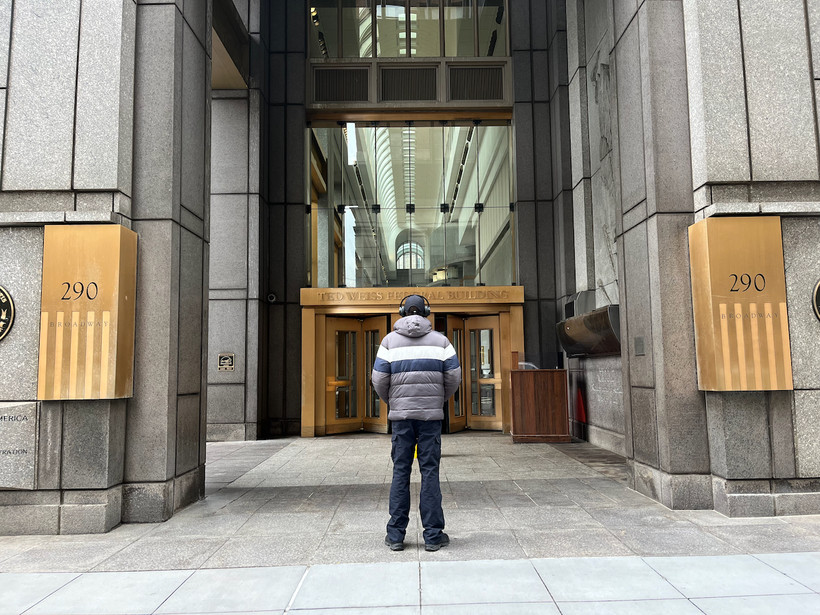
Modou stands in front of the New York federal building where a judge ordered him removed to Uganda, a country he's never visited. | Liv Veazey / New York Focus

Sign up for Staying Focused, our newsletter keeping readers up to speed on New York politics.

Modou sat with his lawyer in the quiet hallway of the immigration court on the 21st floor of a Manhattan federal building. It was a Wednesday afternoon late last month, and he was waiting for the next hearing in his asylum case. He wore black sweatpants, a blue corduroy suit jacket, and a tie.

For two years, Modou had compiled evidence that, if the United States deported him to his home country of Senegal, he’d face persecution for marrying someone of a different faith. In his asylum application, he’d meticulously described the violence and death threats he’d faced, supporting his story with medical and government records, certificates, news articles, and testimony from family and friends.

Yet in January, an Immigration and Customs Enforcement lawyer petitioned the judge in Modou’s case to throw out his claim before the court could even consider it.

Instead of Senegal, ICE wanted to send Modou to Uganda, 4,500 miles from his home country. He’d never been to Uganda, or even thought of visiting. He and his lawyer scrambled; they had just a few weeks to argue a whole new case.

In the courthouse hallway, Modou’s attorney coached him in whispers.

“They’re not going to ask you anything about Senegal,” she told him. “Don’t even bring it up.”

She drilled him on the questions an ICE cross-examiner would likely ask.

“Why are you afraid of going to Uganda if you’ve never even been there?” she posed.

Modou hesitated: “Because I’m a Muslim?” His hands shook. It was Ramadan and he’d been fasting.

After a 30-minute hearing, Modou and his lawyer emerged from the courtroom. The judge ruled that the government could send him to Uganda. His lawyer had told him before his hearing that the judge would likely decide in ICE’s favor, but that didn’t alleviate the shock. “I’m scared,” he said. Modou, whom New York Focus is identifying with a pseudonym to avoid jeopardizing his case, is appealing.

Modou is one of tens of thousands of immigrants across the US who are facing rendition to countries they’re not from and often have never visited. To facilitate the third-country removals, federal attorneys are petitioning courts to throw out asylum seekers’ original cases before they have a chance to argue them. The tactic allows ICE to quickly deny or abandon asylum claims, even as it struggles to follow through on the actual renditions.

“They’re not going to ask you anything about Senegal. Don’t even bring it up.”

—Modou's attorney

In New York state, the one-two punch is widespread and disproportionately affecting African asylum seekers like Modou, according to immigration court statistics that Joseph Gunther, an independent researcher, and Brandon Morrow of the data service bklg compiled for New York Focus. Of the roughly 2,350 African asylum seekers with hearings in New York between December and February, just under 50 percent were subject to motions to abandon their cases and, in most cases, send them to a third country. For those from Latin America, that number was about 29 percent.

Of the African cases whose motions were ruled on, judges approved about 66 percent — with most granting removal to Uganda.

The cases are dismissed through a legal process known as a “pretermission.” The technique was rarely employed before last year, when the Department of Justice, which runs the immigration court system, issued a policy memo that encouraged immigration judges to accept pretermission motions. In November, motions to pretermit asylum cases skyrocketed.

In the motions, ICE attorneys point to agreements the Trump administration has signed with other countries to take asylum seekers the US wants to deport. Since those third countries state they can safely accept the migrants, the government lawyers argue, asylum seekers’ claims that they face harm if returned to their home countries are moot. Aside from Uganda for Africans, the Trump administration has signed the agreements with Honduras, Guatemala, and Ecuador, where it is seeking to send Latin Americans.

ICE has sent roughly 50 third-country nationals to Guatemala, 140 to Honduras, and an undisclosed number to Ecuador, but it hasn’t yet sent any non-Ugandans to Uganda. That’s due in part to the fact that Uganda has not released an implementation plan outlining how it would provide safe conditions and paths to asylum for the deportees from the US.

The future of the practice remains unclear: Last week an ICE memo reportedly instructed attorneys to pause the tactic, though it didn’t say for how long.

The practice is also being challenged in federal court. The lawsuit, originally filed against the first Trump administration, claims that the countries with which the US has entered into the agreements don’t qualify as safe places to seek asylum. In the case of Uganda, the plaintiffs point out that the US’s own State Department describes extrajudicial killings and torture of dissidents and death penalties and imprisonment for homosexuality in Uganda.

Some Ugandan officials have also pushed back against the arrangement. The day before the agreement was officially announced in August, the Ugandan minister of state for foreign affairs told Reuters that the country does “not have the facilities and infrastructure to accommodate” the asylees. Uganda already hosts nearly 2 million refugees — more than any other African country. After funding shortfalls left it unable to feed them, the country closed its borders to new refugees from multiple neighboring countries late last year.

“Nobody understands,” Modou said. “Everyone is just talking about Uganda, Uganda, Uganda.” | Liv Veazey / New York Focus


Despite the lack of follow-through thus far, African asylum seekers remain terrified of the potential choice between deportation to a country they fled and rendition to a country they know little about. West Africans are trying to make sense of why a judge told them that they’d be sent to Uganda when the government hasn’t sent anyone there yet.

“Nobody understands,” Modou said. “Everyone is just talking about Uganda, Uganda, Uganda.”

For immigration attorneys, pretermission cases are exceptionally difficult to prepare. A strong asylum claim usually requires evidence that one has already suffered persecution at the hands of specific people. That’s nearly impossible for someone who has never been to the country where they fear persecution, even if their fear is well-founded.

Pretermission cases also face an accelerated timeline. ICE attorneys are filing their motions with almost no lead-time before a hearing, blowing past deadlines set by judges, said Melanie Zamenhof, senior attorney at Neighbors Link Community Law Practice.

“Sometimes it is the morning of, one hour before, or literally an oral motion made at that moment,” Zamenhof said.

That often leaves attorneys just days or even hours to respond to a pretermission motion and argue that an entirely new country is unsafe for their clients. For standard asylum cases, most clients work with their attorneys for at least a year to prepare material.

ICE did not respond to a request for comment.

“The judge can just put their case in the trash.”

—Melanie Zamenhof, immigration attorney

For their part, judges move quickly on scheduling and deciding pretermission cases. Half of the African cases that received a pretermission motion between November 2025 and January 2026 were decided by January 31, according to Gunther and Morrow’s analysis. Nearly nine in 10 of those cases received a ruling in under 30 days, and one in 10 was decided on the same day the motion was filed.

For Modou’s case, his attorney, Stefi Bastiaensz, filed over 200 pages of affidavits, reports, and articles on Uganda to argue that the country can’t offer Modou safety — all in about three weeks.

Zamenhof said that some of the strongest cases she’s handled in her career are getting pretermitted. “For folks who did everything the right way, at any time prior to a hearing, the judge can just put their case in the trash,” she said. She described burnout and turnover among her colleagues as they buckle under the weight of the increased workload.

Zamenhof is currently representing a family of five from West Africa. The father, Alpha, whom New York Focus is also identifying with a pseudonym to avoid jeopardizing his case, came to the US with his pregnant wife and two of their children. He left his career as a surgeon after he and his family received threats and were attacked because of their ethnicity and his opposition to the government, he said. He has been trying for two and a half years to transfer his certifications and begin practicing medicine again. He often works multiple jobs, including one as an assistant manager at a Dollar Tree.

Alpha and his wife each filed their own asylum claims, both of which ICE attorneys sought to dismiss in order to send the family to Uganda. “I was so, so afraid,” Alpha said. He’s been speaking with other African asylum seekers in the same situation. “A lot of people are saying they would rather be in prison here than in Uganda,” he said.

A judge denied the motion to abandon Alpha’s case, but granted it for his wife’s case. He said that he hasn’t told his kids about the judge’s decision and wasn’t sure what would happen to his US citizen baby if his wife was sent to Uganda or he was deported.

Alpha has a final asylum hearing scheduled for this month. The family is hoping that he’ll win and that he can add his wife to his asylum application.

While he waits for the judge’s decision, Alpha said that he’s trying to lay low. Just recently, he said, a customer spit on his face while he was working. When his coworkers asked him why he didn’t fight back, he said, “We are not coming here to have problems. We are coming here to be alive.”

At New York Focus, our central mission is to help readers better understand how New York really works. If you think this article succeeded, please consider supporting our mission and making more stories like this one possible.

New York is an incongruous state. We’re home to fabulous wealth — if the state were a country, it would have the tenth largest economy in the world — but also the highest rate of wealth inequality. We’re among the most diverse – but also the most segregated. We passed the nation’s most ambitious climate law — but haven’t been meeting its deadlines and continue to subsidize industries hastening the climate crisis.

As New York’s only statewide nonprofit news publication, our journalism exists to help you make sense of these contradictions. Our work scrutinizes how power works in the state, unpacks who’s really calling the shots, and reveals how obscure decisions shape ordinary New Yorkers’ lives.

In the last two decades, the number of local news outlets in New York has been nearly slashed in half, allowing elected officials and powerful individuals to increasingly operate in the dark — with the average New Yorker none the wiser.

We’re on a mission to change that. Our work has already shown what can happen when those with power know that someone is watching, with stories that have prompted policy changes and spurred legislation. We have ambitious plans for the rest of the year and beyond, including tackling new beats and more hard-hitting stories — but we need your help to make them a reality.

If you’re able, please consider supporting our journalism with a one-time gift or a monthly gift. We can't do this work without you.

Thank you,

Akash Mehta
Editor-in-Chief
A photo of Akash Mehta.
Liv covers immigration for New York Focus. She previously reported for Hell Gate, where she wrote about ICE arrests in immigration court, city culture, and the 2025 mayoral election. Before becoming a journalist, she practiced and taught oral history in New York City… more
Also filed in New York State

We’ve compiled information for the 450,000 New Yorkers who will lose health care coverage on July 1.

A lobbyist who has been romantically linked to Assembly Speaker Carl Heastie led a rally opposing the legislation a week before the speaker declined to bring it to a vote.

In May, state lawmakers passed a $269 billion budget after haggling for months over thousands of line items and policies affecting New Yorkers.

Also filed in New York City

The citizens assembly model, used for public decision-making around the world, is gaining traction in New York.

Resorts World is floating legislation to avert more than $500 million in payments to the horseracing industry.

Some of the city’s new aid will be canceled out by pension boosts.

Also filed in Immigration

The Department of Justice has terminated more than 100 immigration judges since last year as it has pressured courts to order more deportations.

The legislation comes after months of haggling over how best to protect New Yorkers from President Trump’s immigration crackdown.

Footage published by New York Focus sparked a debate over deputies’ practice of calling Border Patrol on Spanish-speaking drivers.