Thousands Wait for Long-Term Help While Hochul Pushes Involuntary Commitment

In some counties, the waitlist for state-funded mental health treatment programs can exceed two years.

Julia Rock and Chris Gelardi   ·   April 22, 2025
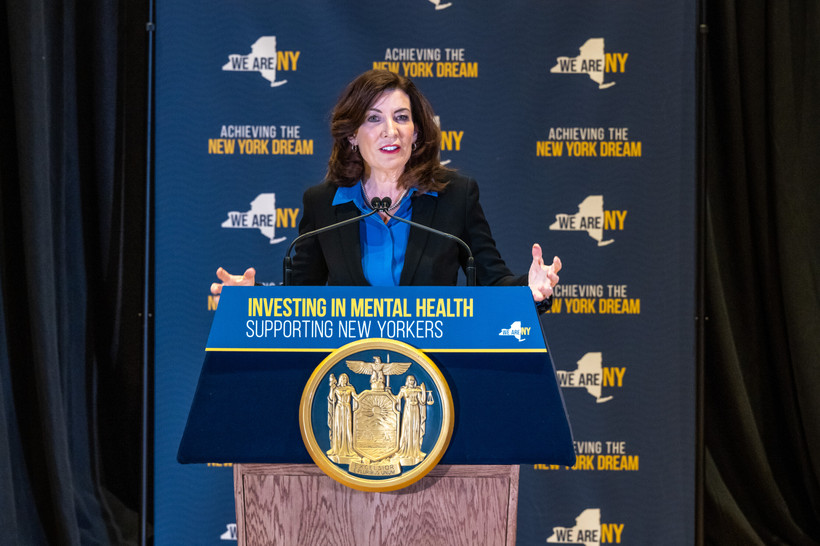
Some applicants wait years for voluntary long-term mental health support, even as the state has increased funding for such programs in recent years. | Photo: Office of Governor Kathy Hochul

Sign up for Staying Focused, our newsletter keeping readers up to speed on New York politics.

Thousands of New Yorkers around the state are sitting on waitlists for two state-funded mental health treatment and support programs, according to data obtained by the Legal Aid Society and reviewed by New York Focus. Some applicants wait years for voluntary long-term mental health support, even as the state has increased funding for such programs in recent years, the records show.

The state and mental health advocates have embraced the programs — supportive housing and Assertive Community Treatment — as effective ways to help people with serious mental illnesses. Supportive housing programs offer people subsidized apartments or community residences staffed with service providers. ACT teams provide around-the-clock services and recovery programs, allowing people to live in their communities rather than in hospitals.

While the state has boosted funding for the programs in recent years, there are more people seeking treatment than can receive it, and mental health advocates have said more is needed to meet that demand.

The Legal Aid Society requested supportive housing and ACT data from 49 counties around the state over the past year. At the time they responded, all of the 19 jurisdictions that maintain the relevant data, including rural and urban areas as well as New York City, had waitlists for supportive housing programs, ranging from one month to more than two years. In some cases, the number of applicants on a county’s waitlist was nearly double the available beds.

Some of the counties did not have ACT programs, which are funded by the state and federal governments and administered by nonprofits. Eight counties reported that they have waitlists for ACT, while five counties said they do not.

In February, advocates asked legislative leaders to boost funding for mental health and supportive housing programs in their budget proposals. In a letter, dozens of groups asked the state to expand ACT to eliminate waitlists, fund more supportive housing, and increase pay for mental health clinicians, among other measures.

The Senate proposed new funding for ACT this year, but Hochul and the Assembly did not. Hochul proposed some new funding for the state’s supportive housing programs, although advocates warn it would not be enough to keep all existing units from falling into disrepair or going offline. The legislature proposed a bigger funding boost for two of the programs. Hochul is currently negotiating a deal with the legislature on her flagship mental health budget item — to expand police and clinicians’ power to involuntarily hospitalize people experiencing mental health crises.

Advocates and downstate lawmakers contend that the governor’s push to expand involuntary commitment — which involves coerced, short-term hospitalizations — overshadows the role of the voluntary supportive services that might prevent crises in the first place. Funding for such services may be in jeopardy after the Trump administration slashed federal grants. Last month, Hochul announced that the state Office of Mental Health expects to lose $27 million.

“We don’t think it makes sense to expand involuntary commitment when we know that people are waiting for voluntary services,” said Nadia Chait, senior director of policy and advocacy for the Center for Alternative Sentencing and Employment Services, which receives state funding to provide mental health treatment.

Asked for comment, Hochul’s office referred New York Focus to the Office of Mental Health.

“The proposed changes to the state’s involuntary commitment law are designed to ensure those most at risk of serious harm can get critical inpatient care before they are connected with the outpatient supports designed to help them live safely and stably in the community,” an OMH spokesperson said in a statement.

As many as 5 percent of New York adults struggle with severe mental illnesses, according to the state comptroller’s office, and there’s been a sharp uptick in the number of people receiving mental health care from state programs in the past decade. But state leaders and advocates largely agree that more support is needed.

State leaders have weighed how to tackle the challenge and its overlap with homelessness, which has more than doubled in New York in recent years. Some politicians, including Hochul, have framed the issue as one of public safety in the wake of extremely rare but high-profile assaults by people experiencing mental health crises.

“We have underinvested in mental health care for so long, and allowed the situation to become so dire, that it has become a public safety crisis as well,” Hochul said in 2023.

That year, the governor announced a $1 billion, multi-year investment in the state’s mental health system. Since then, the state has expanded its ACT and supportive housing programs. New York had launched 25 new ACT teams across the state and opened nearly 1,300 new OMH-funded supportive housing beds as of January. More of both are on the way, though Trump’s federal cuts would hit both adult and youth ACT programs, Hochul’s office said.

The state has plans to build over 2,200 more short- and long-term supportive housing residences. That’s a start, said Doug Cooper, interim executive director of the Association for Community Living, an organization of nonprofit housing and rehabilitation providers — but not nearly enough.

“We don’t think it makes sense to expand involuntary commitment when we know that people are waiting for voluntary services.”

—Nadia Chait, Center for Alternative Sentencing and Employment Services

“To New York state and OMH’s credit, they are adding units every year,” Cooper said, adding that New York has far more mental health supportive housing than other states. But building and staffing new units takes a long time, and the demand still far outweighs the supply.

The supportive housing waitlist in Westchester County alone was close to 1,300 people, records show, while Suffolk County’s was nearly 1,600 people long last May. Even in counties with significantly shorter waitlists, like Lewis and Monroe, people seeking supportive housing have had to wait anywhere from a few months to nearly a year.

Assessing the full extent of supportive housing demand is impossible, Cooper said, but his organization estimates that there’s a roughly 30,000-bed shortfall. “We just don’t have the capacity,” he said.

“Something like mental health emergency crisis apartments, the wait time could be two to three months,” said Lauren Nakamura, a staff attorney with the Legal Aid Society, referencing the new data. “‘Emergency crisis’ implies a level of urgency, and if even those spots are not available, then there’s a real problem.”

“Governor Hochul’s $1 billion investment to strengthen our mental health system has significantly expanded outpatient behavioral health services, outreach teams, peer support and specialized housing statewide,” the OMH spokesperson said.

In addition to ACT and supportive housing expansion, OMH pointed to new regulations aimed at helping people connect with support when they leave inpatient treatment, dozens of new support teams to help people find and coordinate housing and care, and a planned expansion of the behavioral health clinics system.

Hochul herself has acknowledged that the recent cash infusions aren’t filling all the gaps. In her State of the State speech in January, she said the investments in the state’s mental health system had not been adequate to tackle what she describes as a problem of “severely mentally ill and homeless” people on the streets, particularly in the New York City transit system.

“We cannot allow our subway to be a rolling homeless shelter,” she said, and held up expanding involuntary commitments as a solution.

Hochul’s proposal includes changes to state laws that allow police to remove people experiencing mental health crises from their homes or the streets and take them to a hospital if officers or a clinician assess that the person poses a risk to themself or others. The proposal would expand the scenarios under which authorities can involuntarily commit someone, including if they “are at substantial risk of harm due to their inability to meet basic needs like food, shelter, or medical care.”

“It’s kicking the can down the road.”

—Lauren Nakamura, Legal Aid Society

The mayors of all of the state’s largest cities have voiced their support for Hochul’s proposal. Mayor Eric Adams similarly expanded involuntary commitment in New York City three years ago. While it’s difficult to pinpoint the impact the expansion has had on residents’ access to intensive mental health care, data shows that people sent to hospitals under involuntary commitment laws often are not admitted.

Last year, police officers in New York City transported people to the hospital on 7,721 occasions under the state mental hygiene law, according to city data. In most instances, people were taken from their residences, not from the subway or the streets. And for those transports where the relevant data is available, 42 percent of people who were taken to the hospital — some in handcuffs — weren’t actually admitted for inpatient treatment. Meanwhile, homelessness in New York City is currently higher than at any point in the past two decades, when the city first started keeping track.

“Expanding involuntary removals and commitments is not going to actually address the problem that [Hochul] wants it to solve,” said Alison Wilkey, director of government affairs for the Coalition for the Homeless. “People who were involuntarily removed are going to the hospital and then being released back into the streets and subways without the care that they need.”

Mental health advocates say the approach often does more harm than good, especially when there aren’t services to help people when they leave the hospital. “It’s kicking the can down the road,” said Nakamura of Legal Aid. Many have pushed for an approach like the one used in supportive housing and ACT programs, which keeps people in their communities or connects them with housing if they’re homeless.

The city has its own capacity issues with supportive housing and ACT. Homeless people accepted into supportive housing programs, whether for mental health care or other types of services, waited an average of 367 days as of last summer. Meanwhile, many supportive housing units in the city are empty for a variety of reasons, including because they need improvements or because people can’t afford the rent.

The city placed over 1,400 people on an ACT waitlist last year. There were 672 people on the waitlist as of last month, Gothamist reported. (OMH said this week that its planned ACT expansion “is expected to eliminate the existing ACT waitlist in New York City,” though it’s unclear how federal cuts will impact those plans.)

According to Cooper, of the Association for Community Living, Hochul’s involuntary commitment proposal makes expanding supportive housing even more urgent.

“If they’re going to strengthen involuntary commitment, there has to be the investment in services for that to work,” he said.

Neither the Senate nor the Assembly included Hochul’s proposed changes to the involuntary commitment laws in their own budgets, and the topic has been one of a number of policy issues that is holding up budget negotiations. As of last week, no deal had been reached, according to Jo Anne Simon, chair of the Assembly Committee on Mental Health. The status of negotiations over supportive housing and ACT funding are unclear.

“There is a problematic assumption that if somebody isn’t being treated, that it needs to be coercive,” said Simon. “The real problem with people not getting treatment is the unavailability of treatment.”

At New York Focus, our central mission is to help readers better understand how New York really works. If you think this article succeeded, please consider supporting our mission and making more stories like this one possible.

New York is an incongruous state. We’re home to fabulous wealth — if the state were a country, it would have the tenth largest economy in the world — but also the highest rate of wealth inequality. We’re among the most diverse – but also the most segregated. We passed the nation’s most ambitious climate law — but haven’t been meeting its deadlines and continue to subsidize industries hastening the climate crisis.

As New York’s only statewide nonprofit news publication, our journalism exists to help you make sense of these contradictions. Our work scrutinizes how power works in the state, unpacks who’s really calling the shots, and reveals how obscure decisions shape ordinary New Yorkers’ lives.

In the last two decades, the number of local news outlets in New York has been nearly slashed in half, allowing elected officials and powerful individuals to increasingly operate in the dark — with the average New Yorker none the wiser.

We’re on a mission to change that. Our work has already shown what can happen when those with power know that someone is watching, with stories that have prompted policy changes and spurred legislation. We have ambitious plans for the rest of the year and beyond, including tackling new beats and more hard-hitting stories — but we need your help to make them a reality.

If you’re able, please consider supporting our journalism with a one-time gift or a monthly gift. We can't do this work without you.

Thank you,

Akash Mehta
Editor-in-Chief
A photo of Akash Mehta.
Julia Rock is a reporter for the Financial Times. She was previously an investigative reporter at New York Focus and The Lever.
A photo of Chris Gelardi
As New York Focus’s justice bureau chief, Chris Gelardi reports and edits work on the state’s criminal-legal and immigration systems. His writing on cops, jails, ICE, and the US military has appeared in more than a dozen other outlets, most frequently The Intercept… more
Also filed in New York State

The legislation would make it easier for currently and formerly incarcerated people and child victims to sue the state over allegations of past abuse.

State leaders are expected to pass a bill that avoids resolving how much Resorts World New York City needs to pay.

New York state has pumped millions of taxpayer dollars into an online portal that vowed to make life easier for Rochester’s neediest, but critics say it’s fallen short.

Also filed in Health

Despite last-ditch efforts by a coalition of lawmakers, the state failed to avert a health coverage cliff coming this summer.

160,000 injured New Yorkers seek workers’ compensation each year — but in recent years, regulators have tilted the scales towards employers and insurers.

Amid abortion bans and rising digital surveillance, Albany lawmakers are revisiting an effort to stop companies from selling sensitive health information.

Also filed in Housing

Some of the city’s new aid will be canceled out by pension boosts.

A law designed to protect the environment will be partially rolled back to pave the way for much-needed homes.

After a New York Focus investigation, a Bronx charity distributed nearly $400,000 to survivors of a deadly 2022 fire.

Also filed in Explainers

We’ve compiled information for SNAP recipients in New York on the changing work requirements.

We answer your questions on the state’s notoriously opaque budget process.

Unions want state leaders to sweeten their retirement packages. What would it cost, and what would it achieve?

Also filed in Social Services

The Hochul administration now has a chance to relax New York’s child care staffing ratios — among the country’s strictest — after 26 years. But will it?

New rules could result in thousands of New Yorkers losing their food benefits this summer.

Nearly half a million New Yorkers on the Essential Plan could lose their coverage this summer.