The State Is Making New York City Spend $275 Million More for Child Care Vouchers

The state budget, finalized this week, increased the spending requirement on the city for the first time since the 1990s.

Julia Rock   ·   May 9, 2025
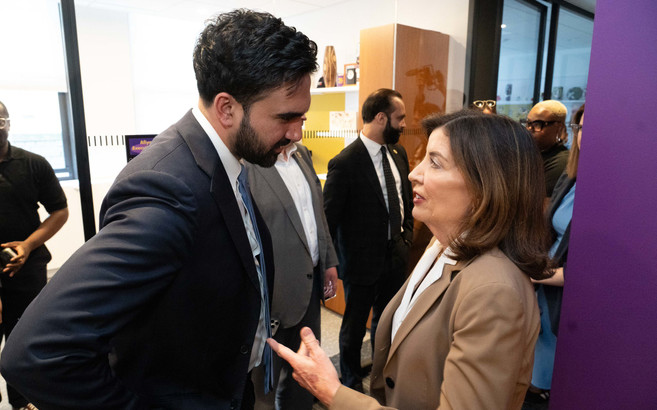
The state is raising the minimum amount that New York City must spend on the program to $328 million a year. | Photos: Benny Polatseck/Mayoral Photography Office; Darren McGee/ Office of Governor Kathy Hochul | Illustration: Maha Ahmed

Sign up for Staying Focused, our newsletter keeping readers up to speed on New York politics.

The state budget approved by legislators this week gives $350 million in additional funding to help New York City continue providing child care vouchers to low-income families — if the city throws in the same amount of its own money.

There’s another major caveat buried in the fine print: The state is raising the minimum amount that New York City must spend on the program to $328 million a year. Even if the city doesn’t want to pay to get the matching funds, the new requirement could force it to.

Right now, New York City contributes just under $53 million to the Child Care Assistance Program, which is largely funded by the federal and state governments and covers almost the entire cost of child care for low-income families. That means the state is mandating the city increase its spending more than sixfold.

When asked what would happen if New York City doesn’t meet the new minimum, Division of Budget spokesperson Tim Ruffinen simply said, “They’re statutorily required to.”

The budget does not include such a change for any of the state’s 57 other local social service districts, which administer the child care subsidies.

New York City warned earlier this year that — absent more state money — it would have to start removing thousands of parents a month from the Child Care Assistance Program due to an impending funding shortfall. Governor Kathy Hochul and the city have since been in a monthslong standoff over who should pay.

The vouchers provide a lifeline for working parents in New York City who would otherwise face annual child care costs averaging more than $20,000, among the highest in the country.

Earlier this week, Deputy Mayor Randy Mastro announced the city was pausing enrollment and setting up a waitlist. Meanwhile, more than a dozen counties around the state, facing their own funding shortfalls, have also set up waitlists.

New York City’s shortfall has several causes. The state expanded eligibility for the vouchers in recent years, boosting enrollment. On top of that, the state adjusted the market rate for provider pay, which increased city spending on the program by 20 percent. And the city expected that more parents were soon going to need the vouchers, because the city was going to resume enforcing work requirements for public assistance recipients, which had been paused during the pandemic.

After Hochul’s January executive budget did not include any new funding, 49 state legislators from the city, all but two members of the New York City Council, and many advocates asked Albany for more money. They said the city needed about $900 million to ensure that parents did not lose assistance and that new applicants would not be turned away.

The Children’s Agenda, a Rochester-based advocacy organization, estimated that non-NYC districts needed an additional $213 million to ensure they could keep providing vouchers to eligible parents.

The final budget agreement meets neither demand. The program will see an additional $400 million overall, with $350 million for New York City and $50 million for the rest of the state.

“This is good news compared to the situation we were in in February,” said Dede Hill, policy director at Schuyler Center for Analysis and Advocacy, a social policy and advocacy organization.

“The state has done its part, and now it’s on Mayor Eric Adams to ensure that thousands of parents do not lose [their vouchers].”

—New York City Council Member Lincoln Restler

The money for New York City comes with strings. In order to access the full amount, the city must contribute an equal sum. Any funds it doesn’t match will become available to other counties, also on a matching basis. The $50 million set aside for the rest of the state does not have the matching requirement.

But even more may be at risk. Local social service districts are required to put “maintenance of effort” funds into the Child Care Assistance Program. That amount was set by a formula from the mid-1990s. This year, the budget requires New York City to increase its contribution to $328 million.

Albany is “requiring the city to spend an enormous amount more on child care than they currently do,” said Pete Nabozny, policy director at the Children’s Agenda, a Rochester-based advocacy organization. “They haven’t done this since the ‘maintenance of effort’ levels were established in the 1990s.”

It is not clear what will happen if New York does not meet the minimum requirement, Nabozny said. Matching the state’s $350 million for additional funds would also fulfill its maintenance of effort obligation, but Mayor Eric Adams’s own budget proposal this month did not include any new money for the program. The city has not yet indicated whether that will change in response to the finalized state plan.

Adams has argued that the state should cover the full cost of the funding shortfall. He and other local leaders see it as largely a state program: The state sets most of the rules for the Child Care Assistance Program, and has covered the cost of its expansion in recent years.

“We are still evaluating this new and unforeseen funding requirement imposed on the city by the state — on what was always a fully state-funded program,” an Adams spokesperson said in a statement. “But the bottom line is that Mayor Adams is never going to shortchange New York City’s most vulnerable children.”

New York City Council Member Lincoln Restler, who has been vocally advocating for more funding, called the final agreement an “enormous victory for working families.”

“The state has done its part, and now it’s on Mayor Eric Adams to ensure that thousands of parents do not lose” their vouchers, he said.

Hochul’s office did not respond to a request for comment by publication time.

Update: May 12, 2025 — This article has been updated to include a comment provided by Mayor Eric Adams's office after publication.

At New York Focus, our central mission is to help readers better understand how New York really works. If you think this article succeeded, please consider supporting our mission and making more stories like this one possible.

New York is an incongruous state. We’re home to fabulous wealth — if the state were a country, it would have the tenth largest economy in the world — but also the highest rate of wealth inequality. We’re among the most diverse – but also the most segregated. We passed the nation’s most ambitious climate law — but haven’t been meeting its deadlines and continue to subsidize industries hastening the climate crisis.

As New York’s only statewide nonprofit news publication, our journalism exists to help you make sense of these contradictions. Our work scrutinizes how power works in the state, unpacks who’s really calling the shots, and reveals how obscure decisions shape ordinary New Yorkers’ lives.

In the last two decades, the number of local news outlets in New York has been nearly slashed in half, allowing elected officials and powerful individuals to increasingly operate in the dark — with the average New Yorker none the wiser.

We’re on a mission to change that. Our work has already shown what can happen when those with power know that someone is watching, with stories that have prompted policy changes and spurred legislation. We have ambitious plans for the rest of the year and beyond, including tackling new beats and more hard-hitting stories — but we need your help to make them a reality.

If you’re able, please consider supporting our journalism with a one-time gift or a monthly gift. We can't do this work without you.

Thank you,


Julia Rock is a reporter for the Financial Times. She was previously an investigative reporter at New York Focus and The Lever.
Also filed in New York State

In May, state lawmakers passed a $269 billion budget after haggling for months over thousands of line items and policies affecting New Yorkers.

Millions in outside spending was a boon to Gov. Kathy Hochul’s 2022 opponent, Lee Zeldin, and influenced down-ballot races.

The legislation would make it easier for currently and formerly incarcerated people and child victims to sue the state over allegations of past abuse.

Also filed in New York City

Resorts World is floating legislation to avert more than $500 million in payments to the horseracing industry.

Some of the city’s new aid will be canceled out by pension boosts.

The Department of Justice has terminated more than 100 immigration judges since last year as it has pressured courts to order more deportations.

Also filed in Social Services

New York state has pumped millions of taxpayer dollars into an online portal that vowed to make life easier for Rochester’s neediest, but critics say it’s fallen short.

We’ve compiled information for SNAP recipients in New York on the changing work requirements.

Despite last-ditch efforts by a coalition of lawmakers, the state failed to avert a health coverage cliff coming this summer.