Court Records Undercut Bronx DA’s Testimony on Discovery Rollbacks

Hochul’s proposed rollbacks are one of the major sticking points in this year’s budget negotiations. One prosecutor’s support rested on a faulty anecdote.

Ryan Kost   ·   April 8, 2025
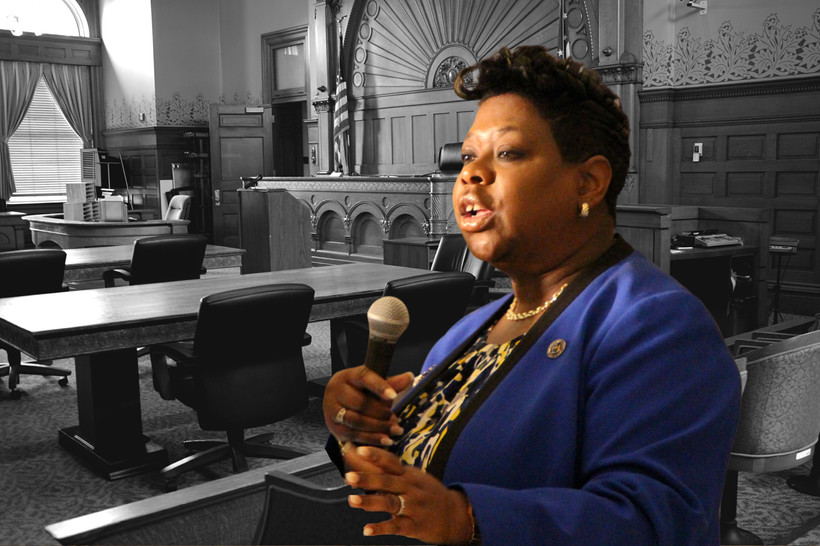
Negotiations over the budget, which was due April 1, are ongoing, and the governor’s discovery rollbacks have been one of the biggest sticking points. | Photos: Ruben Diaz Jr. / Flickr; ftwitty / Getty Images | Illustration: Leor Stylar

Sign up for Staying Focused, our newsletter keeping readers up to speed on New York politics.

A New York City district attorney gave inaccurate testimony about one of the state’s most contentious political issues during a February legislative hearing, according to court documents recently reviewed by New York Focus.

Bronx DA Darcel Clark was testifying about discovery law, which governs the process by which prosecutors and defense attorneys share evidence with each other ahead of criminal trials. Governor Kathy Hochul proposed changes to the law in January that would water down some aspects of New York’s 2019 criminal justice reforms.

Clark and other district attorneys have supported Hochul’s proposal, claiming that since the reforms, judges have been throwing out strong criminal cases and overturning convictions on minor technicalities.

Public defenders, on the other hand, have argued that current law gives prosecutors plenty of opportunity to rectify evidence-sharing issues, and that judges are dismissing cases based on real failures to comply.

In other words, what a prosecutor might call a minor technicality, a defense attorney might call a core legal obligation.

To bolster their claims, DAs have offered anecdotes about serious criminal charges that judges threw out over what the prosecutors say are inconsequential discovery-related violations. But most have been difficult to verify, because cases are generally sealed after they’re dismissed, meaning the court records aren’t publicly available.

Available data shows an increase in discovery-related dismissals in New York City but doesn’t offer much information on the details underlying them. A review of hundreds of those dismissals found that judges described them as based on serious failures by prosecutors to meet evidentiary obligations rather than minor technicalities.

Clark’s mixup offers a rare chance to evaluate the underlying facts in a debate that has largely relied on prosecutors’ word against public defenders’. At the February hearing, which took place in the runup to the all-important negotiations over the state’s $250 billion budget, a lawmaker asked Clark for an example of a frivolous dismissal.

In response, Clark shared the cautionary tale of a felony conviction in her county that a judge reversed after the defense attorney had waited until the last minute to raise concerns about a “particular document or something [that] wasn’t turned over.” But that’s not what happened, court records show. Clark inaccurately recalled central details of the case, including the severity of the charges and the defense attorney’s actions.

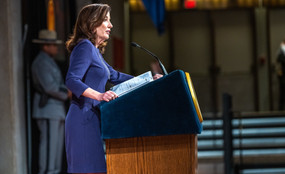
Negotiations over the budget, which was due April 1, are ongoing, and the governor’s proposed discovery rollbacks have been one of the biggest sticking points. In their budget counterproposals last month, neither the Assembly nor the Senate included her proposed discovery policy.

Discovery is a complex legal process that can significantly impact the outcome of a case. Before New York’s 2019 criminal justice reforms, defense attorneys say they often had to build their cases while “blindfolded” from the full range of evidence against their clients. In some cases, their clients accepted plea deals prematurely because of delayed evidence sharing. New York Focus reported last month that evidence withheld at trial has played a role in many wrongful convictions across the state.

Under the reforms, prosecutors are required to hand over a prescribed list of evidence before trial, and a judge can dismiss a case if they fail to do so.

The governor’s proposal would give prosecutors more latitude over what evidence to hand over and make it harder for judges to dismiss cases based on discovery issues.

“In every decision we reviewed, judges document serious, repeated failures by prosecutors—not minor technicalities or procedural tricks by the defense.”

—Scrutinize

Those dismissals are at the center of the debate in Albany. “The dismissals that we’re seeing on technicalities — misdemeanors as well as on felonies — mean that people are not being held accountable,” Clark, the Bronx DA, testified at the February budget hearing.

Clark’s claims echo those made by other New York district attorneys, lobbying groups, and Hochul herself in the last few months. The governor has stressed that her changes “will close fatal loopholes that have delayed trials and led to cases being thrown out on minor technicalities.” And Manhattan District Attorney Alvin Bragg told New York Focus in February that “thousands of cases are now dismissed annually, for reasons that have nothing to do with fairness or justice.”

But proponents have offered little in the way of details. The state District Attorneys Association, which backed Hochul’s proposal, provided New York Focus with a list of seven examples, but could only provide the defendant’s name for one of them. In that case, from Delaware County, the judge dismissed a rape charge when it became clear that the complainant’s medical records were incomplete, noting that the missing records “should be obvious to a prosecutor exercising due diligence.” (Prosecutors are appealing the ruling, according to an association spokesperson.)

There’s no publicly available data on just how many criminal cases are dismissed over “minor technicalities,” though some numbers appear to show that, in New York City, overall discovery-related dismissals have likely increased significantly in the last few years. In the rest of the state, that number has remained low. The judicial reform group Scrutinize reviewed nearly 300 sealed decisions in New York City involving discovery violations from recent years and found that “in every decision we reviewed, judges document serious, repeated failures by prosecutors—not minor technicalities or procedural tricks by the defense.”

The group notes that its dataset is limited due to sealed records: “It is possible that other cases paint a different picture—but that picture remains hidden from public view.”

On the whole, this makes it difficult to verify prosecutors’ claims. The example Clark gave to state legislators provides some insight.

Clark spoke on a panel at the hearing alongside public defense advocates and Rensselaer County DA Mary Pat Donnelly, the incoming president of the state District Attorneys Association. Assemblymember Latrice Walker, from Brooklyn, asked Clark for specifics. “Can you tell me one from your county where that actually happened?” she asked.

“This is how bad this one was,” Clark replied. She told the story of a defense attorney who she claimed had taken advantage of a loophole in the law by waiting until after the jury had found the defendant guilty to raise concerns about a missing document. At that point, the judge overturned the felony verdict. “Now that’s something that could have been dealt with before we went to trial,” said Clark.

New York Focus reviewed sealed court transcripts from the 2024 trial Clark referenced, and it appears she got key details wrong. The transcripts, which omitted the defendant’s name, matched publicly available records, including dates and the names of attorneys involved.

The case in question did not actually involve a felony charge, but rather misdemeanor charges for driving under the influence.

As for the missing document, the defense attorney had in fact addressed the issue as soon as it came up. Months before trial, the legal services organization Bronx Defenders had requested disciplinary records for four police officer witnesses. (Defense attorneys can use past conduct to call an officer’s credibility into question.)

The prosecution turned over some records and stated that they had complied with discovery rules. A week into the trial, after the jury had been selected and testimony was underway, the DA’s office announced they’d found additional disciplinary records for three of four testifying officers.

“Can you tell me one from your county where that actually happened?”

—Assemblymember Latrice Walker
Ultimately, it was the judge who opted to wait until after the trial to rule on the issue. The defense attorney responded to the new disclosures by asking Judge E. Deronn Bowen to dismiss the case. Instead, the judge tabled the issue because the jury had already been seated. The jury found the defendant guilty, but when the judge turned back to the discovery issue, he found that the prosecution had failed to do its job and overturned the conviction.

The judge said it was the DA’s responsibility to make sure “lines of communication with NYPD are open to the degree [sic] and make sure that stuff that is months old doesn’t get turned over to the People and then to Defense until after trial.” He went on to cite “the sheer variety, the sheer breadth, the sheer diversity” of the late disclosures and concluded, “I’m not even confident that the People have, at this point, gotten everything.”

Though it’s not clear why the records appeared so late in this case, defense advocates have rallied behind a separate reform that would give prosecutors direct access to police electronic records systems, reducing the possibility of a communication breakdown between law enforcement agencies.

Clark’s office did not comment on the discrepancy between the two accounts, but a spokesperson said that under the governor’s proposed changes, a showing of “harm/prejudice to the defendant” would be required to dismiss a case entirely. “This case would not have been dismissed under that standard.” He said the office is appealing the ruling.

“Time and time again, District Attorneys have trotted out misleading anecdotes and fearmongering to attack New York’s discovery reform. But the facts tell a different story,” said Eli Northrup, an attorney with the Bronx Defenders, in a written statement.

“The vast majority of case dismissals have nothing to do with strict deadlines or ‘technicalities’ — they happen either because prosecutors fail to exercise basic diligence, or because the case was never viable in the first place,” he wrote. Northrup, who was not the defense attorney in the case, said Bronx Defenders could not comment on the case or discrepancy itself because the records had been sealed.

Earlier in the hearing, Donnelly, the Rennsselaer DA, told legislators about a violent felony that had been thrown out over a missing police report that offered no new information. When asked for details about the case, her office could not offer any identifying information.

According to Donnelly’s chief of staff, the story came from a different county altogether, and though Donnelly had written to the district attorney there for more information, she hadn’t heard back.

“Sorry I can’t be of more assistance,” said the chief of staff.

BEFORE YOU GO, consider: If not for the article you just read, would the information in it be public?

Or would it remain hidden — buried within the confines of New York’s sprawling criminal-legal apparatus?

I started working at New York Focus in 2022, not long after the outlet launched. Since that time, our reporters and editors have been vigorously scrutinizing every facet of the Empire State’s criminal justice institutions, investigating power players and the impact of policy on state prisons, county jails, and local police and courts — always with an eye toward what it means for people involved in the system.

That system works hard to make those people invisible, and it shields those at the top from scrutiny. And without rigorous, resource-intensive journalism, it would all operate with significantly more impunity.

Only a handful of journalists do this type of work in New York. In the last decades, the number of local news outlets in the state has nearly halved, making our coverage all the more critical. Our criminal justice reporting has been cited in lawsuits, spurred legislation, and led to the rescission of statewide policies. With your help, we can continue to do this work, and go even deeper: We have endless ideas for more ambitious projects and harder hitting investigations. But we need your help.

As a small, nonprofit outlet, we rely on our readers to support our journalism. If you’re able, please consider supporting us with a one-time or monthly gift. We so appreciate your help.

Here’s to a more just, more transparent New York.

Chris Gelardi
Justice Bureau Chief
A photo of Chris Gelardi
Ryan Kost is an investigative reporter based in New York City focusing on courts and the criminal justice system. He has been a staff writer for The San Francisco Chronicle, The Oregonian and The Associated Press. His work has also appeared in The… more
Also filed in Criminal Justice

In May, state lawmakers passed a $269 billion budget after haggling for months over thousands of line items and policies affecting New Yorkers.

The legislation would make it easier for currently and formerly incarcerated people and child victims to sue the state over allegations of past abuse.

It’s unclear whether the Correctional Association of New York will have to scale back its nascent reform initiatives.

Also filed in New York State

A lobbyist who has been romantically linked to Assembly Speaker Carl Heastie led a rally opposing the legislation a week before the speaker declined to bring it to a vote.

Millions in outside spending was a boon to Gov. Kathy Hochul’s 2022 opponent, Lee Zeldin, and influenced down-ballot races.

State leaders are expected to pass a bill that avoids resolving how much Resorts World New York City needs to pay.

Also filed in Budget

Resorts World is floating legislation to avert more than $500 million in payments to the horseracing industry.

Our searchable database breaks down the most consequential decisions Albany politicians made on climate, immigration, housing, schools, taxes, and more.

Advocates welcomed the additional funding but said it falls short of need and doesn’t do enough to support workers.

Also filed in New York City

Some of the city’s new aid will be canceled out by pension boosts.

The Department of Justice has terminated more than 100 immigration judges since last year as it has pressured courts to order more deportations.

After a New York Focus investigation, a Bronx charity distributed nearly $400,000 to survivors of a deadly 2022 fire.