Whatever Happened With the State’s ‘Migrant Relocation’ Program?

The initiative to resettle asylum seekers outside New York City reached half the targeted number of familes. ICE has deported some participants.

Isabelle Taft   ·   September 29, 2025
State lawmakers approved the Migrant Relocation Assistance Program in spring 2023. | Office of Governor Kathy Hochul

Sign up for Staying Focused, our newsletter keeping readers up to speed on New York politics.

A state program to resettle immigrant families outside of New York City enrolled its last participants this summer. The Migrant Relocation Assistance Program, or MRAP, helped thousands escape crowded shelters and establish livelihoods in communities across the state. But its rollout was slow, it faced backlash from county governments, and it ended up helping around half the families it hoped to. Tens of thousands left city shelters with no relocation support.

Now, some members of families who found stability through the program are being arrested and deported — swept up in President Donald Trump’s immigration crackdown, as New York Focus reported this week.

What was the embattled program?

Why did the state launch MRAP?

During the Biden administration, immigration at the southern border reached historic levels thanks in part to new policies around asylum and parole and global forces like economic crises in Haiti and Venezuela. Over 200,000 immigrants made their way to New York City between 2022 and 2024.

A decades-old “right to shelter” mandate compelled the city to provide temporary housing for the new arrivals, some of whom were bused in by Governor Greg Abbott of Texas. The shelter system quickly became overwhelmed. Families and officials alike were eager for a solution more permanent than adding more shelter beds, but amid a housing crunch in the city, it was difficult for newly arrived families to find apartments. Mayor Eric Adams demanded that Governor Kathy Hochul do more to help.

State lawmakers approved $25 million for a Migrant Relocation Assistance Program in spring 2023, aiming to relocate 1,250 families. In officials’ telling, the program could at once relieve crowding in city shelters, give families better housing at far less cost to the government, and help newly arrived immigrants put down roots in parts of New York with lower costs of living.

How did it work?

MRAP paid participants’ rent for a year, gave them funds to buy food, and provided them with case management services to help them look for work and enroll their kids in school.

The idea of relocation met backlash from many county administrations, who issued executive orders aimed at keeping asylum seekers out. Hochul refused a request from New York City to resettle new arrivals over local objections, leaving potential MRAP participants limited to five counties: Albany, Erie, Monroe, Suffolk, and Westchester.

Staff at New York City shelters were responsible for identifying and recruiting families to participate. Only those who had applied for asylum or another form of deportation protection were eligible. The requirement ensured that participants could qualify for work permits, but it also created a bottleneck: Applying for asylum is a complex, time-consuming process, and families struggled to navigate it soon after arriving in the city.

Did it succeed?

MRAP quickly faced criticism for its slow rollout. By August 2023, a month after it launched, New York Focus reported that MRAP had resettled exactly zero families. By the following February, The New York Times reported it had moved 174 families into permanent housing.

The pace of resettlement never really took off. Ultimately, only 671 families — some 2,000 people — participated, according to a state spokesperson. Lawmakers allocated an additional $7.5 million to the program in 2024, even though it ended up resettling half the target number of families. Meanwhile, nearly 200,000 people left the shelter system without relocation support, according to a report by the Coalition for the Homeless. Nearly 37,000 immigrants remained living in city shelters as of July.

“It was really a wan and half-hearted effort to appear to be doing something,” said Dave Giffen, executive director of the Coalition for the Homeless.

Leaders of some of the nonprofits that administered the program told New York Focus that it worked well for people who were able to participate. The Ibero-American Action League, which ran MRAP services for 363 families in Monroe and Albany counties, reported that more than 60 percent of adults were able to get jobs during their year in the program. Angélica Pérez-Delgado, Ibero’s president and CEO, said the slow rollout and now immigration arrests affecting MRAP families have overshadowed the program’s successes.

“I am sad that this environment stole our thunder to be able to say, ‘This is a cost-effective way to help people integrate and become self-sufficient in this country,’” she said.

How do participants feel about it?

New York Focus interviewed members of six MRAP families in Rochester and Buffalo. Several described the program as “a blessing” that enabled them to put down roots. One opened her own restaurant within a year of moving to Rochester, where she had no friends or relatives before she arrived.

Program administrators said some people were frustrated by long waits for work authorization and the challenge of finding jobs and child care in places where they had little preexisting community. Some left the program early. Others left the state after finishing their MRAP year, or fell out of contact with administrators.

Alexander Aparicio said he felt an almost spiritual certainty that he, his wife, and their two kids should go to Buffalo from the moment he heard it was an option. Opportunity seemed to knock at his door — like the social worker who came by their room in a New York City hotel shelter one day to discuss MRAP.

Once in Buffalo, Aparicio and his wife landed jobs at a hotel. Their kids like school, he said. They now pay the rent on the apartment MRAP placed them in nearly two years ago.

“The program ended, we made it through another year, and we’re settled here,” he said.

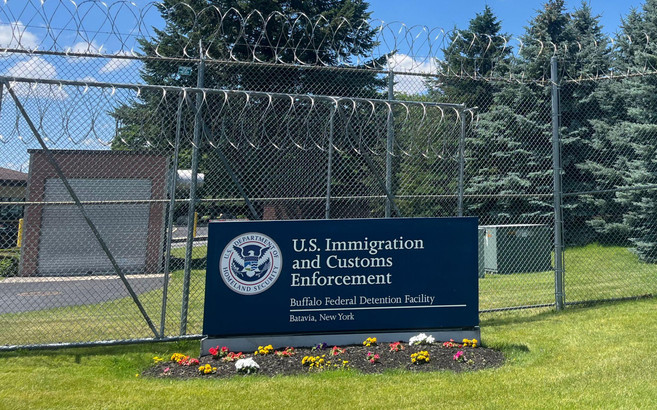
Even for those who’ve found success in the program, Trump’s election changed things. ICE has detained or deported members of at least 19 MRAP families around Rochester, Buffalo, and Albany.

A, who asked that her name not be used because she’s received threats after talking to the media in her home country of Peru, said ICE briefly detained her husband in July, but agents let him go after he showed them his work permit, driver’s license, and social security card. The incident shattered any sense of safety they had built in Buffalo, she said.

Ultimately, more practical issues pushed A to leave. Her children never quite adjusted to western New York. They missed the school they attended in Queens, where more of the other students spoke Spanish. This year, A didn’t enroll her boys in school in Buffalo. This month, they moved back to New York City.

At New York Focus, our central mission is to help readers better understand how New York really works. If you think this article succeeded, please consider supporting our mission and making more stories like this one possible.

New York is an incongruous state. We’re home to fabulous wealth — if the state were a country, it would have the tenth largest economy in the world — but also the highest rate of wealth inequality. We’re among the most diverse – but also the most segregated. We passed the nation’s most ambitious climate law — but haven’t been meeting its deadlines and continue to subsidize industries hastening the climate crisis.

As New York’s only statewide nonprofit news publication, our journalism exists to help you make sense of these contradictions. Our work scrutinizes how power works in the state, unpacks who’s really calling the shots, and reveals how obscure decisions shape ordinary New Yorkers’ lives.

In the last two decades, the number of local news outlets in New York has been nearly slashed in half, allowing elected officials and powerful individuals to increasingly operate in the dark — with the average New Yorker none the wiser.

We’re on a mission to change that. Our work has already shown what can happen when those with power know that someone is watching, with stories that have prompted policy changes and spurred legislation. We have ambitious plans for the rest of the year and beyond, including tackling new beats and more hard-hitting stories — but we need your help to make them a reality.

If you’re able, please consider supporting our journalism with a one-time gift or a monthly gift. We can't do this work without you.

Thank you,

Akash Mehta
Editor-in-Chief

A photo of Akash Mehta.
A photo of Isabelle Taft.
Isabelle Taft covers immigration for New York Focus. She’s also a corps member with Report for America, a national program that places reporters in local newsrooms. She previously covered national news as a fellow at the New York Times, worked on the health… more
Also filed in New York State

State leaders are expected to pass a bill that avoids resolving how much Resorts World New York City needs to pay.

New York state has pumped millions of taxpayer dollars into an online portal that vowed to make life easier for Rochester’s neediest, but critics say it’s fallen short.

Resorts World is floating legislation to avert more than $500 million in payments to the horseracing industry.

Also filed in New York City

Some of the city’s new aid will be canceled out by pension boosts.

The Department of Justice has terminated more than 100 immigration judges since last year as it has pressured courts to order more deportations.

After a New York Focus investigation, a Bronx charity distributed nearly $400,000 to survivors of a deadly 2022 fire.

Also filed in Immigration

The legislation comes after months of haggling over how best to protect New Yorkers from President Trump’s immigration crackdown.

Footage published by New York Focus sparked a debate over deputies’ practice of calling Border Patrol on Spanish-speaking drivers.

Shelter providers have had to lay off staff, while the children’s already uncertain futures have become even murkier.

Also filed in Explainers

We’ve compiled information for SNAP recipients in New York on the changing work requirements.

We answer your questions on the state’s notoriously opaque budget process.

Amid abortion bans and rising digital surveillance, Albany lawmakers are revisiting an effort to stop companies from selling sensitive health information.

Also filed in Social Services

Despite last-ditch efforts by a coalition of lawmakers, the state failed to avert a health coverage cliff coming this summer.

The Hochul administration now has a chance to relax New York’s child care staffing ratios — among the country’s strictest — after 26 years. But will it?

New rules could result in thousands of New Yorkers losing their food benefits this summer.