ICE Collaboration and Prisons in Crisis: Four Questions for State Law Enforcement

A hearing Thursday gives lawmakers an opportunity to grill police and prison leaders.

Chris Gelardi   ·   February 11, 2026
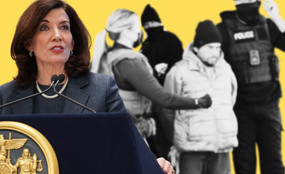
Thursday's hearing will offer a rare chance for lawmakers to publicly grill State Police officials. | Photo: Christopher Ebdon/Flickr | Illustration: New York Focus

Sign up for Staying Focused, our newsletter keeping readers up to speed on New York politics.

It’s an uncertain time for New York law enforcement. President Donald Trump has toyed with the idea of sending troops into New York City even though reported violence is nearing historic lows. His administration has also threatened the state with an incursion by federal immigration agents. Officials are debating whether to use cops to protect residents against Immigration and Customs Enforcement abuses and how to prevent law enforcement from enabling raids that are already underway.

The state’s prisons, meanwhile, are in such dire straits after a guard strike and mass firing that, for a second consecutive year, Governor Kathy Hochul wants to use the National Guard to help staff them. It’s unclear when all of the system’s 42 facilities will resume normal operations.

The public has questions, and on Thursday, it could get some answers. That’s when the state legislature will hold an annual hearing on public safety, part of a monthlong marathon of sessions aimed at unpacking Hochul’s state budget proposals. The hearings offer a rare opportunity for lawmakers to publicly grill state agency heads about events of the past year and their plans for the year ahead.

On criminal justice, there’s much to discuss — but frustratingly little time to discuss it. Legislators on relevant committees each get between three and 10 minutes to interrogate testifiers.

Luckily, New York Focus is here to help. Here are four questions our justice bureau chief would ask the state’s law enforcement leaders.

When do state cops help ICE?

A collection of executive orders, court rulings, and laws limit how state and local law enforcement interact with federal immigration enforcement, but New York’s policies are less stringent than those enacted by some other blue states, such as Illinois and Oregon. Progressive legislators and immigrant rights groups have long advocated for sweeping sanctuary legislation. Last month, as nationwide protests against ICE actions swelled, Hochul proposed a pared-down version of what advocates have been pushing for.

Hochul’s bill would bar local police and sheriffs from entering into formal agreements with ICE, but it would still allow for informal collaboration. When New York Focus asked a local police chief who recently signed one of the formal agreements how the bill would affect his department’s participation in ICE raids, he responded: “It wouldn’t.” The lack of a contract would simply preclude ICE from paying his department for its help, he said.

Hochul’s proposal would also do little to curb potential collaboration between the New York State Police and ICE. An executive order prohibits state authorities from asking about someone’s immigration status and sharing information with the feds for the purpose of civil immigration enforcement. The guidelines are less clear when a case involves criminal charges, including criminal immigration charges like crossing the border illegally. Last year, Hochul’s office released a list of circumstances in which state authorities are allowed to assist immigration agents, all of which focused on criminal investigations, but the list was vague and her office declined to elaborate on them.

That leaves key questions unanswered. How and when do the State Police work with federal immigration authorities? Are they helping ICE track down people accused of being in the country illegally? Do they follow Hochul’s guidance? If so, how do they interpret it?

What information does state law enforcement share with the feds?

Even when cops aren’t directly helping ICE, they could be enabling the agency’s crackdown.

Since 9/11, the federal government has created a vast information-sharing network that funnels intelligence from state and local police to the feds and vice versa. The clearest example is the national network of fusion centers, regional hubs that bring together local, state, and federal law enforcement to share information. The network is run by ICE’s umbrella agency, and ICE’s deportation branch recently touted its heavy use of fusion center resources.

As governor, Hochul has expanded New York’s participation in this information-sharing network. The State Police operate one of the country’s oldest fusion centers — the New York State Intelligence Center, or NYSIC — and the governor has funneled millions of dollars into boosting its surveillance capabilities, including by launching a social media monitoring team.

While the center’s operations are largely secret, it’s likely that ICE can access much of the intelligence it compiles. Last year, for example, New York Focus uncovered a NYSIC-run gang registry that’s accessible to ICE.

Police gang databases have been shown to contain widespread errors, encourage racial profiling, and turn low-level infractions into major criminal cases. They’re sometimes used to target immigrants. The State Police said last year that its gang database has never been audited. Who in Albany is overseeing the State Police’s use of this powerful tool?

And how often does ICE query NYSIC? Do the State Police know how immigration authorities are using the data they make available to the fusion center? Have they put any safeguards in place to limit ICE’s use of the data?

Is prison chaos the new normal?

Nearly one year ago, amid increased scrutiny over the filmed murder of an incarcerated man by corrections officers, New York state prison guards launched a wildcat strike. Hochul deployed the National Guard to help staff the prisons. The strike lasted three weeks and led to the firing of some 2,000 guards.

Since then, the prison system has been operating in a consistent state of crisis. Citing a staffing shortage, the system has kept its facilities in varying states of lockdown, with incarcerated people confined to their cells and dorms, often missing school and programs — including programs they need to complete to earn their release.

The Department of Corrections and Community Supervision, which runs the state prison system, has claimed it is recruiting new staff and working on returning to normal operations, but the pace of progress has been glacial. In her budget proposal for next fiscal year, Hochul proposed $535 million to extend the National Guard deployment. If approved, it would put the total cost of the strike at over $1.2 billion.

How long can the state sustain that level of support? Is it necessary? When will DOCCS reach its recruitment goals?

Are prisons following the law?

To help deal with its post-strike crisis, DOCCS has stopped following several parts of a 2022 solitary confinement reform law.

Even before the strike, DOCCS never came into full compliance with the law, known as the HALT Act, as New York Focus has reported. It’s unpopular among corrections officers, who claim they need freedom to use isolation to maintain order and cited HALT as one of the reasons they went on strike. The prison agency has come up with creative legal arguments to water down what legislators describe as some of its basic tenets. In response to a lawsuit last year, DOCCS claimed that HALT doesn’t apply to a vast majority of the people it incarcerates. The law’s main sponsor called the interpretation “demonstrably false.”

Can DOCCS and lawmakers come to an agreement on what HALT requires of the prison system? How many incarcerated people remain confined in illegal conditions? When will DOCCS come into full compliance with the law?

BEFORE YOU GO, consider: If not for the article you just read, would the information in it be public?

Or would it remain hidden — buried within the confines of New York’s sprawling criminal-legal apparatus?

I started working at New York Focus in 2022, not long after the outlet launched. Since that time, our reporters and editors have been vigorously scrutinizing every facet of the Empire State’s criminal justice institutions, investigating power players and the impact of policy on state prisons, county jails, and local police and courts — always with an eye toward what it means for people involved in the system.

That system works hard to make those people invisible, and it shields those at the top from scrutiny. And without rigorous, resource-intensive journalism, it would all operate with significantly more impunity.

Only a handful of journalists do this type of work in New York. In the last decades, the number of local news outlets in the state has nearly halved, making our coverage all the more critical. Our criminal justice reporting has been cited in lawsuits, spurred legislation, and led to the rescission of statewide policies. With your help, we can continue to do this work, and go even deeper: We have endless ideas for more ambitious projects and harder hitting investigations. But we need your help.

As a small, nonprofit outlet, we rely on our readers to support our journalism. If you’re able, please consider supporting us with a one-time or monthly gift. We so appreciate your help.

Here’s to a more just, more transparent New York.

Chris Gelardi
Justice Bureau Chief

A photo of Chris Gelardi
As New York Focus’s justice bureau chief, Chris Gelardi reports and edits work on the state’s criminal-legal and immigration systems. His writing on cops, jails, ICE, and the US military has appeared in more than a dozen other outlets, most frequently The Intercept… more
Also filed in Criminal Justice

A bill awaiting the governor’s signature would relax restrictions on who can qualify for victim compensation.

In May, state lawmakers passed a $269 billion budget after haggling for months over thousands of line items and policies affecting New Yorkers.

The legislation would make it easier for currently and formerly incarcerated people and child victims to sue the state over allegations of past abuse.

Also filed in New York State

At a Board of Regents meeting Monday, state officials proposed eliminating credit-based diploma requirements.

The last-minute influx, the biggest ever for a legislative primary, is boosting her opponent, Jessica González-Rojas.

City budget gaps and an ambitious affordability agenda may require pressing Albany again for taxes and aid.

Also filed in Budget

State leaders are expected to pass a bill that avoids resolving how much Resorts World New York City needs to pay.

Resorts World is floating legislation to avert more than $500 million in payments to the horseracing industry.

Our searchable database breaks down the most consequential decisions Albany politicians made on climate, immigration, housing, schools, taxes, and more.

Also filed in Immigration

A lawsuit accuses federal officials of ignoring evidence that the boy, born in Mexico, held US citizenship through his mother.

We’ve compiled information for the 450,000 New Yorkers who will lose health care coverage on July 1.

The Department of Justice has terminated more than 100 immigration judges since last year as it has pressured courts to order more deportations.