What Zohran Mamdani’s Win Means for Climate Politics

The mayor-elect’s approach reflects a view that is going mainstream: To succeed, climate policies may need to lose the label.

Colin Kinniburgh   ·   November 5, 2025
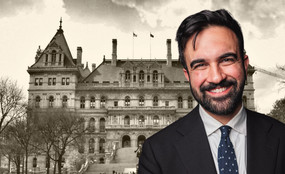
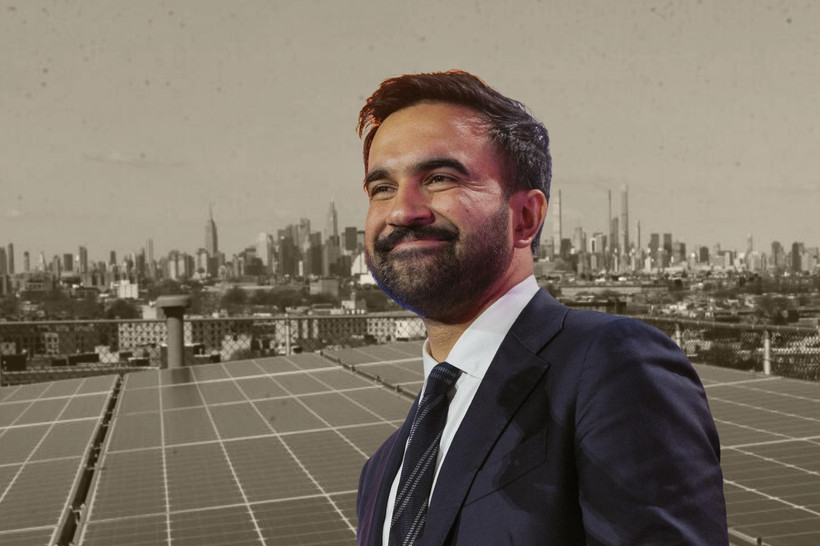
A photo collage of Zohran Mamdani in front of a roof with solar panels on it; a cityscape in the background.
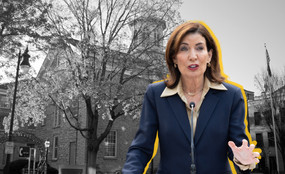
Mayor-elect Zohran Mamdani's climate approach is a sharp contrast to that of other New York politicians, like Governor Kathy Hochul, who’ve framed green goals as clashing with cost-of-living issues. | Photos: Zohran Mamdani/Facebook; nyc.gov | Illustration: New York Focus

Sign up for Staying Focused, our newsletter keeping readers up to speed on New York politics.

Zohran Mamdani barely campaigned on climate.

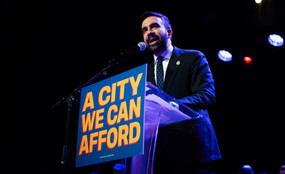
The New York City mayor-elect’s overwhelming focus has been on affordability, from an early ad declaring that “the cost of living is the real crisis” to his victory speech before a jubilant crowd in Brooklyn on Tuesday night. That focus didn’t stop him from winning a first-of-its-kind endorsement from a prominent climate group, the youth-led Sunrise Movement, in late April, long before he had the backing of progressive icons like Alexandria Ocasio-Cortez and Bernie Sanders.

The national group had never endorsed a mayoral candidate before, but poured its energy into the Mamdani campaign. By the time the Democratic primary arrived in June, Sunrise said its local volunteers had knocked on more than 20,000 doors in support of the candidate. They continued into the fall, and ended up knocking on about 40,000 doors, said Denae Ávila-Dickson, the group’s communications and political manager.

What Sunrise saw in Mamdani was a way of “reaching people where they were at,” Ávila-Dickson said.

“Zohran was talking about climate action in a way people could understand, and people were able to see the impacts of this climate action in their everyday lives,” she said, pointing to his promises of fast and free buses and his proposal for greening public schools — the single headline climate policy in his platform.

Others, too, see in Mamdani’s campaign the seeds of a new green economic populism that could rally popular support around climate-friendly policies — if not under a climate banner.

His emphasis on the cost of living is “very different from how we typically see climate policy developed, especially in the US, where people usually experience climate policy as high-level, technocratic fixes,” said Batul Hassan, labor director at the think tank Climate and Community Institute and a steering committee member of the New York City Democratic Socialists of America. Mamdani offers a way “to tie the climate action that we need to kitchen table concerns,” she said.

Whether intentionally or not, the mayor-elect’s approach reflects a view that is going mainstream in climate circles: To succeed, climate policies need to lose the label.

“Climate and quality of life are not two separate concerns,” Mamdani told The Nation magazine in April. “They are, in fact, one and the same.”

His approach is a sharp contrast to that of other New York politicians, like Governor Kathy Hochul, who’ve framed green goals as clashing with cost-of-living issues.

So what is Mamdani’s climate agenda, and can he demonstrate a way to drive down emissions and costs at the same time?

Upgrading Old Buildings …

Buildings remain by far New York City’s largest source of climate-heating pollution, accounting for more than 70 percent of local greenhouse gas emissions.

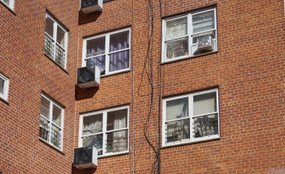
The city’s chief effort to address that, and the closest thing to a hot-button climate issue in the mayoral race, is Local Law 97. The law required large buildings to start meeting emissions limits last year, with far stricter caps coming between 2030 and 2050. That will require fixes as small as replacing lightbulbs and tuning boilers at first, and ultimately phasing out all oil and gas appliances.

More than 90 percent of buildings are complying with the initial requirements, the city recently reported, and Mamdani has promised to continue “fulfilling the vision” of the law.

Some co-op, condo, and landlord groups have fought the law, arguing that it will cost too much to bring their buildings into line. One anti-Mamdani PAC sought to make Local Law 97 a defining issue in the race, distributing fliers to co-op and condo owners that warned they could “say goodbye to [their] life savings” if he wins.

Mamdani says he wants to help middle-income co-op and condo owners come into compliance with the law by lobbying Albany to extend a tax break that helps pay for building renovations, and reducing the fees to apply. He wants to staff up the city office in charge of walking building owners through the necessary upgrades. And he suggested in a recent debate that the city could provide affordable heat pumps directly to residents, building on a model the public housing authority has already tested, with promising results.

At least one climate group, the Spring Street Climate Fund, is keen on the approach, including it in a new list of policy proposals for the incoming administration.

“Climate is in the background of the mayoral race. I think climate is in the background in politics more broadly now,” said Spring Street president John Raskin. “The way to bring it to the foreground is … to find where action on climate can substantively address the things that people are worried about day to day.”

Raskin said that the city could achieve that by ramping up efforts to bring cleaner heating, cooling, and cooking to residents, and set an example beyond New York.

The main climate policy in Mamdani’s official platform also focuses on green building upgrades: retrofitting 500 schools inside and out with solar panels, greener schoolyards, and more. This plan will likely require Albany’s sign-off to raise spending limits for school construction.

… And Building New Ones

For some, Mamdani’s promise to build 200,000 new units over 10 years is just as important as his plans to clean up existing buildings.

Thanks to its density, New York City remains one of the most climate-friendly cities in the country: Apartments tend to be more energy-efficient than single-family homes, and New Yorkers rely less on cars than any of their peers around the country. That alone means there are climate benefits to making it more affordable for people to move to and stay in the city, some economists say.

“The best thing we can be doing for climate in New York City is putting far more people in New York City by building more housing for them,” said Paul Williams, executive director of the think tank Center for Public Enterprise. 

The city is also working to make new homes greener. The city’s all-electric buildings law already rules out fossil fuels from most new construction, and the law will extend to virtually all buildings by the middle of Mamdani’s term.

Fast and Free Buses

Transportation, the city’s next-largest source of emissions, has been a focal point of Mamdani’s campaign. His proposal to make buses free and fast is among the three main planks of his affordability agenda — a bid to save people not just the fares but “precious time for family, leisure and rest.” And, he said in a February interview, it “can actually reduce a lot of the carbon emissions across our city.”

Some experts have questioned the pollution benefits of eliminating fares. Experiments around the world have offered little evidence that the policy reduces driving, and therefore emissions.

During the MTA’s test of five free bus lines in 2023–24 — a pilot program that Mamdani helped design — 11 percent of new riders reported that they previously would have taken a car instead. But twice as many previously walked, and the largest share simply switched from the subway or another bus line.

Making buses free citywide will require backing from Albany to make up for the $650 million or more in bus fare revenue that New York City’s public transit system relies on. Some critics say additional funds would be better spent on making the system more reliable.

Yonah Freemark, a land use researcher at the liberal Urban Institute, said scrapping fares could be worthwhile to ensure transit access for low-income and in particular undocumented New Yorkers. “But improving service is a better way to get people out of their cars if you had to pick one,” he said.

Mamdani has emphasized faster service as well, which he could achieve in part with low-cost measures like adding more bus lanes and bus-first signals at intersections. (These policies don’t require Albany’s input.)

His campaign has promised that he can pull off both. Budget negotiations in City Hall and Albany will put that to the test — and likely a stringent one, as the Trump administration threatens ever deeper cuts to transit and other funding that the city relies on.

State-Level Fights

Mamdani will enter office at a moment of reckoning for climate politics across New York state. Hochul, who stumped for him on the campaign trail and whose support he’ll need for at least some of his policies to succeed, has walked back key parts of the state’s climate plan on affordability grounds.

“I had to take a closer look and realize we cannot reach those objectives … in a time frame that’s going to not hurt ratepayers,” she said of the state’s emissions targets in July.

Her administration could in the coming weeks approve a major gas pipeline that the state has repeatedly rejected in the past; it would be the first of its kind in New York in at least a decade. Mamdani came out against the pipeline when asked about it in August, but has not opposed it as vocally as other prominent Democrats. (He has devoted considerable energy to fighting fossil fuel infrastructure in the past, in particular a new gas plant in his Queens neighborhood of Astoria.)

Hochul is also doubling down after a judge ruled last month that the state is violating its flagship climate law and ordered her administration to issue long-delayed rules to implement it. Climate groups sued the state after Hochul shelved her planned “cap and invest” program in January over cost concerns; rather than revive it, she now says she wants to amend the climate law to make the targets easier to reach.

The outcome could have major implications for New York City. The state’s modeling has suggested that low-income city residents are the most likely to reap immediate savings from cap and invest, and the program could bring significant funding for the push to green existing homes.

Mamdani’s team did not respond to New York Focus’s requests for comment. In the Assembly, he has pushed for stronger state action to deliver on the climate law, in particular by building publicly owned renewable energy.

New York’s climate law “is not a suggestion. It is a mandate,” he said a year ago, at a rally demanding the state power authority build more wind and solar.

Mamdani also recently suggested openness to new nuclear energy, but has not explicitly championed Hochul’s plan for the state power authority to build at least one major new power plant upstate.

Climate advocates remain bullish that the mayor-elect shares their priorities, even though he mostly set the issue aside on the campaign trail.

“Of course we worry about policies getting shelved,” said Pete Sikora, who leads climate campaigns at the advocacy group New York Communities for Change. “But the record is what it is: that Mamdani is a climate and jobs and affordability champion.”

He noted that one of Mamdani’s lesser known climate achievements as an assemblymember was defending Local Law 97 when then–governor Andrew Cuomo sought to weaken it in 2021. (Cuomo’s attempt failed.)

“He hasn’t just talked the talk. He’s walked the walk on these issues,” Sikora said. “His record and his commitments are very, very clear.”

I hope this article helped you better answer the question that guides all of our journalism: Who runs New York? Before you click away, please consider supporting our work and making more stories like this one possible.

New York state is standing at a crossroads for climate action. After passing one of the nation’s most ambitious climate laws in 2019, the state is lagging far behind on its targets, struggling to meet deadlines to build renewable energy and clean up its buildings and roads. Other states are closely watching our progress, making decisions about their own climate plans based on New York’s ability to implement this legislation.

As New York’s only statewide nonprofit news publication, we’ve been scrutinizing the state’s climate progress. Our journalism exists to unpack how power works in New York, analyze who’s really calling the shots, and reveal how obscure decisions shape ordinary New Yorkers’ lives.

But we can't do this work without your help. We rely on reader donations to help sustain our outlet, and every gift directly allows us to publish more pieces like this.

Our work has already shown what can happen when those with power know that someone is watching, with my reporting prompting a state investigation and fine for a major corporation. I have more story ideas than I can count, but only limited resources to pursue all the leads that come across my desk.

If you’re able, please consider supporting our journalism with a one-time or monthly gift. Even small donations make a big difference.

Thank you for reading.

Colin Kinniburgh
Climate and Environmental Politics Reporter
A photo of Colin Kinniburgh.
Colin Kinniburgh is a reporter at New York Focus, covering the state’s climate and environmental politics. He has worked in media for more than a decade, across print, television, audio, and online news, and participated in fellowship programs at CUNY’s Graduate School of Journalism… more
Also filed in Elections

The last-minute influx, the biggest ever for a legislative primary, is boosting her opponent, Jessica González-Rojas.

Millions in outside spending was a boon to Gov. Kathy Hochul’s 2022 opponent, Lee Zeldin, and influenced down-ballot races.

Hakeem Jeffries urged Albany to avoid maps that aggressively boosted Democrats, sources told New York Focus.

Also filed in New York City

A lawsuit accuses federal officials of ignoring evidence that the boy, born in Mexico, held US citizenship through his mother.

City budget gaps and an ambitious affordability agenda may require pressing Albany again for taxes and aid.

We’ve compiled information for the 450,000 New Yorkers who will lose health care coverage on July 1.

Also filed in Climate and Environment

The citizens assembly model, used for public decision-making around the world, is gaining traction in New York.

A lobbyist who has been romantically linked to Assembly Speaker Carl Heastie led a rally opposing the legislation a week before the speaker declined to bring it to a vote.

In May, state lawmakers passed a $269 billion budget after haggling for months over thousands of line items and policies affecting New Yorkers.

Also filed in Transit

Some of the city’s new aid will be canceled out by pension boosts.

Oswego County sheriff’s deputies held drivers for up to 45 minutes as they waited for immigration agents, potentially breaking the law.

Critics say the $10 annual fees state drivers pay to fight car insurance theft and fraud aren’t being used as intended.

Also filed in Affordability

We’ve compiled information for SNAP recipients in New York on the changing work requirements.

Despite last-ditch efforts by a coalition of lawmakers, the state failed to avert a health coverage cliff coming this summer.

Governor Kathy Hochul was successful in her bid to upend the Climate Leadership and Community Protection Act after legislators caved to finalize an overall budget deal.